#MondayHealthBurst

MONDAY HEALTH BURST

DEMENTIA – CAUSES, SYMPTOMS, AND TREATMENT

Dementia, also called neurocognitive disorder, is a collective term used to describe various symptoms of cognitive decline. Dementia is not a single disease in itself, but a general term to describe the loss of cognitive functioning – thinking, remembering and reasoning and behavioral abilities to such an extent that it interferes with a person’s daily life and activities. These functions include memory, language skills, visual perception, problem solving, self-management and the ability to focus and pay attention. Some people with dementia find it difficult to control their emotions, and their personalities may change.

Dementia ranges in severity from the mildest stage, when it is just beginning to affect a person’s functioning, to the most severe stage, when the person must depend completely on others for basic activities for living.

The causes of dementia can vary, depending on the types of brain changes that may be taking place. Alzheimer’s disease is the most common cause of dementia. Alzheimer is characterized by “plaques” between the dying cells in the brain and “tangles” within the cells (both are due to protein abnormalities). The brain tissue in a person with Alzheimer’s has progressively fewer cells and connection and the total brain size shrink. Other causes of dementia include;

  • Vascular disorders. These conditions affect the blood circulation in the brain.
  • Traumatic brain injuries caused by car accidents, falls, concussions etc.
  • Infections of the central nervous system. These include meningitis, HIV
  • Long-time alcohol or drug use

Symptoms of dementia can vary greatly. Many conditions are progressive, which means that the signs of dementia start out slowly and gradually get worse. Possible symptoms of dementia compiled and published by the American Academy of Family Physicians (AAFP) include;

  • Recent memory loss- a sign of this might be asking the same question repeatedly
  • Difficulty completing familiar tasks
  • Problems communicating – difficulty with language; forgetting simple words or using the wrong ones.
  • Disorientation
  • Problems with abstract thinking
  • Misplacing things
  • Mood changes

Treatment of dementia depends on its cause. In the case of most progressive dementias, including Alzheimer’s disease, there is no cure and no treatment that slows or stops its progression. But there are drug treatments that may temporarily improve symptoms. The same medications used to treat Alzheimer’s are among the drugs sometimes prescribed to help with symptoms of other types of dementias. Non-drug therapies can also alleviate some symptoms of dementia.

Monday Health Burst is an initiative of CFHI to address issues of basic health concerns. Join us every Monday for more interesting episodes.


MONDAY HEALTH BURST Read More »

MONDAY HEALTH BURST

ENDOMETRIOSIS – CAUSES, SYMPTOMS, AND TREATMENT

Endometriosis, sometimes called “Endo,” is a common health problem in women. It gets its name from the word endometrium, the tissue that normally lines the uterus or womb. Endometriosis happens when tissue similar to the lining of the uterus (womb) grows outside of the uterus and on other areas in the body where it does not belong. It is especially common among women in 30s and 40s and may make it harder to get pregnant. Endometriosis is often found on the ovaries, fallopian tubes, tissues that hold the uterus in place or outer surface of the uterus.

The cause of Endometriosis is yet unknown, However, there are several theories associated with the causes of Endometriosis. The widely accepted theory is that the womb lining does not leave the body properly during a period and embeds itself on the organs of the pelvis. This is known as retrograde menstruation. Other factors include

  • Genetic factors -Because endometriosis runs in families, it may be inherited in the genes.
  • Immune system problems -A faulty immune system may fail to find and destroy endometrial tissue growing outside of the uterus. Immune system disorders and certain cancers are more common in women with endometriosis.
  • Hormones -the hormone estrogen appears to promote endometriosis. Research is looking at whether endometriosis is a problem with the body’s hormone system.
  • Surgery -during a surgery to the abdominal area, such as a Cesarean (C-section) or hysterectomy, endometrial tissue could be picked up and moved by mistake. For instance, endometrial tissue has been found in abdominal scars.

Endometriosis is a long-term (chronic) condition. Symptoms can vary significantly from person to person and some women have no symptoms at all. Yet, the most common symptoms include: painful periods or heavy periods which gets worse overtime; pain in the lower abdomen, pelvis or lower back, pain during and after sex, bleeding between periods, difficulty getting pregnant, painful bowel movements or pain when urinating during menstrual periods. Most women with endometriosis get pain in the area between their hips and the tops of their legs. Some women experience this pain all the time.

Other symptoms may include persistent exhaustion and tiredness, discomfort when defecating,  bleeding from the back passage (rectum) or blood in feces, and coughing blood in rare cases when the endometriosis tissue is in the lung. How severe the symptoms are depends on where in the body the abnormal tissue is, rather than the amount of tissue present. A small amount could be more painful than a large amount. It is worthy of note that Endometriosis is rare in women who are in the menopause stage.

There is presently no cure for endometriosis. Endometriosis can be a difficult condition to deal with, both physically and emotionally but treatments are available for the symptoms and problems it causes. The symptoms of endometriosis can often be managed with painkillers and hormone medication, which help prevent the condition interfering with daily activities. Still, there is no known cure for endometriosis. For women who are not interested in getting pregnant, hormonal birth control is generally the first step in treatment. Patches of endometriosis tissue can sometimes be surgically removed to improve symptoms and fertility also. However, Surgery is usually chosen for severe symptoms, when hormones are not providing relief or if there are fertility problems.

Monday Health Burst is an initiative of CFHI to address issues of basic health concerns. Join us every Monday for more interesting episodes

MONDAY HEALTH BURST Read More »

Schizoaffective Disorder

MONDAY HEALTH BURST

Schizoaffective Disorder in Adolescents
Schizoaffective disorder is part of a cluster of diagnoses called the schizophrenia spectrum and other psychotic disorders. Schizoaffective disorder is a neuropsychiatric or mental disorder in which a person experiences a combination of schizophrenia symptoms and mood disorder symptoms (typically either major depressive disorder or bipolar disorder).
The symptoms and behavior of children and adolescents with schizoaffective disorder may be different from those of adults with this illness. The following symptoms and behaviors can occur in children or adolescents with schizoaffective disorder: Changes in weight or appetite, Suicidal thoughts or attempts, agitation, sleeplessness, and paranoia; depressive symptoms, including sadness, fatigue, trouble concentrating, and loss of interest in daily activities; and/or psychotic symptoms, such as hallucinations, delusions, and confused thinking. Without treatment, the disorder may lead to difficulty functioning at work, at school, and in social situations.
Adolescents schizoaffective disorder is very hard to accurately diagnose, as it is difficult to distinguish from schizophrenia, bipolar disorder, and other mood disorders. Many adolescents with schizoaffective disorder are often initially misdiagnosed with bipolar disorder or schizophrenia.
The greatest risk factor for developing a schizoaffective disorder is generally family history of the same illness or other forms of psychosis, there are a few other risks associated with the development of a schizoaffective disorder in Adolescents, which includes but not limited to drug abuse (Overuse of mind-altering substances such as; methamphetamine, cannabis, cocaine, alcohol, amphetamines, and psychedelics. Some drugs, like ecstasy, can produce lasting or persistent psychosis even after single use in certain individuals) and trauma ( An extremely stressful event triggering latent symptoms. Though trauma is entirely subjective. A horrific event witnessed by multiple persons may only leave one or two struggling with traumatic mental health issues afterwards).
There is no effective cure, but symptoms can be managed and reduced to the point where a normal life without dire consequences can be possible. Adolescents are highly adaptive, and with some therapeutic intervention and possibly the use of medication, most adolescents with schizoaffective disorder can find relief. However, the disorder cannot be completely removed from a person’s mind. Managing it is an ongoing process, and there can be setbacks at times.
Monday Health Burst is an initiative of CFHI to address basic health issues. Join us every Monday on all our social media platforms for more health-related articles.

MONDAY HEALTH BURST Read More »
MONDAY HEALTH BURST

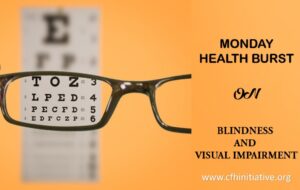
MONDAY HEALTH BURST – BLINDNESS AND VISUAL IMPAIRMENT

Blindness is a complete or partial loss of vision. It is presenting visual acuity of 3/60 or less. Visual impairment on the other hand is often defined as a best corrected visual acuity of worse than 20/40 or 20/60. These could be cataracts, the infectious river blindness, trachoma, glaucoma, diabetic retinopathy, uncorrected refractive errors, and some cases of childhood blindness.

There are variations in the causes of visual impairment across countries. For example, the proportion of visual impairment attributable to cataract is higher in low- and middle-income countries than high-income countries. In high income countries, diabetic retinopathy, glaucoma and age-related macular degeneration are more common. Also, the leading cause of vision impairment among children in low-income countries is congenital cataract, whereas in middle-income countries it is more likely to be retinopathy of prematurity.

The categories of people at risk for blindness include people with eye diseases, such as macular degeneration and glaucoma, people with diabetes, stroke, people undergoing eye surgery, people who work with or near sharp objects or toxic chemicals, and premature babies. However, according to World Health Organization (WHO), more than 1 billion people worldwide are living with vision impairment because they do not get the care they need for conditions like short and far sightedness, glaucoma, cataract in time. This World report on vision by WHO estimates that 80% of visual impairment is either preventable or curable with treatment.

Many people with significant visual impairment benefit from vision rehabilitation, changes in their environment, and assistive devices. In some cases of vision impairment, use of eyeglasses, contact lenses, surgery, and medication may help restore vision, but in the case of irreversible partial or complete blindness, rehabilitation is recommended. Children using glasses are advised to go for medical checkups annually, glaucoma patients for monthly checkups, and people without any confirmed eye problem to go for eye check-up atleast once in 6months.

Monday Health Burst is an initiative of Centre for Family Health Initiative (CFHI) to tackle issues of basic health concerns. Join us every Monday for more health-related articles on all our social media platforms.

MONDAY HEALTH BURST Read More »

MONDAY HEALTH BURST

MONDAY HEALTH BURST

Studies are limited in how effective the use of face masks on healthy individuals affect the outcome of prevention of a respiratory virus. However, during the Covid-19 pandemic, we have seen nations use the precaution of implementing the use of face masks nationwide and have seen remarkable results on the prevention of the spread of the virus together with hand washing and social distancing. This among other studies led to the recommendation of non medical masks by WHO and Nigeria Centre for Disease Control (NCDC).

According to WHO guidelines, appropriate use and disposal of face masks are essential to ensure that they are effective and to avoid any increase in transmission. Hence, the need for proper sensitization to the proper way of using a face mask and how to dispose it, since so many people had little or no knowledge of what a face mask is prior to the pandemic.

Below are recommended steps on the correct use of face masks by Practices in Healthcare Settings:

  • Place the mask carefully, ensuring it covers the mouth and nose and tie it securely to minimize any gaps between the face and the mask.
  • Avoid touching the mask while wearing it.
  • Remove the mask appropriately by not touching the front of the mask but untie from behind.
  • After removal, clean hands using an alcohol-based hand sanitizer or wash with soap and water.
  • Replace masks as soon as they become dampened.
  • Do not re-use single-use masks.
  • Discard single-use masks after each use and dispose of them immediately upon removal.
  • For non medical masks, make sure to wash with disinfectant as well as soap and water after single use and make sure to dry under the sun. It is also advisable to have more than one non medical mask.

#StaySafe #MondayHealthBurst

MONDAY HEALTH BURST Read More »