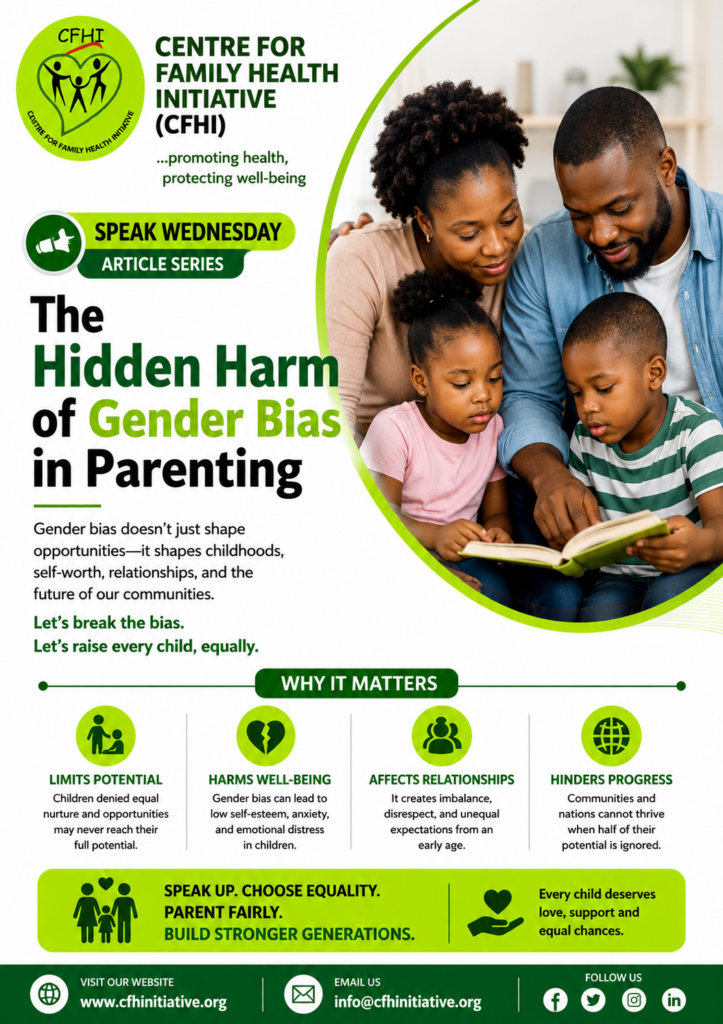
Parenting is one of the most influential responsibilities in shaping a child’s future. Yet, many parents unknowingly raise their children through the lens of gender bias, assigning different expectations, opportunities, emotions, and responsibilities to boys and girls based solely on societal stereotypes. While these practices may seem harmless or culturally acceptable, their long-term consequences can be damaging to children’s mental health, self-esteem, educational outcomes, and overall well-being.
Gender bias in parenting occurs when children are treated differently because of their sex. It often begins early in life. Boys may be encouraged to be strong, assertive, and emotionally reserved, while girls may be expected to be gentle, obedient, and nurturing. These expectations influence how children view themselves and their place in society (1).
Research shows that children begin developing gender awareness between the ages of two and five. During this period, parents play a critical role in shaping beliefs about what boys and girls can or cannot do. When children are repeatedly exposed to restrictive gender messages, they may limit their own aspirations and abilities based on those expectations rather than their true interests and potential (1,2).
One of the most significant hidden harms of gender-biased parenting is its impact on mental health. Boys who are constantly told to “man up,” “be tough,” or “stop crying” may learn to suppress emotions rather than express them in healthy ways. Over time, emotional suppression can contribute to anxiety, depression, anger-related problems, and difficulties in seeking help when needed. Mental health experts have long emphasized that emotional expression is essential for psychological well-being regardless of gender (3).
Girls, on the other hand, often face pressure to prioritize appearance, compliance, and caregiving roles. Constant messages about being “good,” “quiet,” or “beautiful” can create unrealistic standards that undermine self-confidence and self-worth. Research has linked gender stereotypes and restrictive expectations to increased risks of low self-esteem, anxiety, body image concerns, and reduced leadership aspirations among girls (2,4).
Gender bias can also affect educational and career development. For example, boys may be discouraged from pursuing interests perceived as feminine, such as nursing, caregiving, or the arts, while girls may receive less encouragement in science, technology, engineering, and mathematics (STEM) fields. These biases limit children’s opportunities and reinforce inequality across generations (1,5).
Another overlooked consequence is the effect on family relationships. When boys are given greater freedom while girls face stricter controls, or when household responsibilities are distributed unequally based on gender, feelings of resentment and unfairness may develop. Such experiences can affect sibling relationships and shape attitudes toward equality in adulthood (5).
Studies have also found that parental gender attitudes are associated with children’s emotional and behavioral outcomes. Children raised in environments with rigid gender expectations may experience higher levels of emotional distress and difficulties adjusting socially, highlighting the importance of equitable parenting practices (6).
Addressing this issue requires intentional action from parents, caregivers, educators, and communities. Parents can start by encouraging children to explore their interests freely, regardless of gender stereotypes. Household chores should be shared fairly among boys and girls. Children should be taught that emotions are normal and healthy for everyone to express. Parents should also challenge harmful statements such as “boys don’t cry” or “girls can’t do that” whenever they arise.
Furthermore, schools, religious institutions, community organizations, and policymakers must support efforts that promote gender equality and positive parenting practices. Parenting programs that encourage gender-transformative approaches have shown promise in reducing harmful norms and creating healthier environments for children (7).
Every child deserves the freedom to grow, learn, dream, and thrive without the limitations imposed by gender stereotypes. When parents nurture children based on their unique strengths rather than societal expectations, they help raise a generation that is healthier, more confident, emotionally resilient, and better prepared to contribute positively to society.
The hidden harm of gender bias in parenting is not always visible, but its effects are profound. By recognizing and addressing these biases today, we can create a future where every child has an equal opportunity to reach their full potential.
As parents, caregivers, educators, and community leaders, let us examine our own beliefs and practices. Let us create homes where boys and girls are equally valued, equally heard, and equally supported. By challenging gender stereotypes and embracing inclusive parenting, we can protect children’s mental health, promote equality, and build a more just and compassionate society for future generations.
References
- UNICEF. Equal Treatment from Day One: Gender-Responsive Parenting.
https://www.unicef.org/parenting/child-development/what-gender-responsive-parenting - American Psychological Association (APA). Gender Stereotypes.
https://dictionary.apa.org/gender-stereotype - BMJ Mental Health. Universal, Selective and Indicated Parenting Interventions to Prevent Adverse Mental Health Outcomes in Youth.
https://mentalhealth.bmj.com/content/28/1/e301613 - UNICEF. Tackling Gender Inequality From the Early Years.
https://www.unicef.org/reports/tackling-gender-inequality-early-years - UNICEF. Resource Package and Training Modules for Promoting Gender-Transformative Parenting.
https://www.unicef.org/reports/resource-gender-transformative-parenting - Aguirre E., Benzeval M., Murray A. (2024). Parental Gender Attitudes and Children’s Mental Health: Evidence from the UK Household Longitudinal Study.
https://www.sciencedirect.com/science/article/pii/S0277953624000765 - BMJ Mental Health. Early Parenting Interventions to Prevent Internalising Problems in Children and Adolescents.
https://mentalhealth.bmj.com/content/26/1/e300811