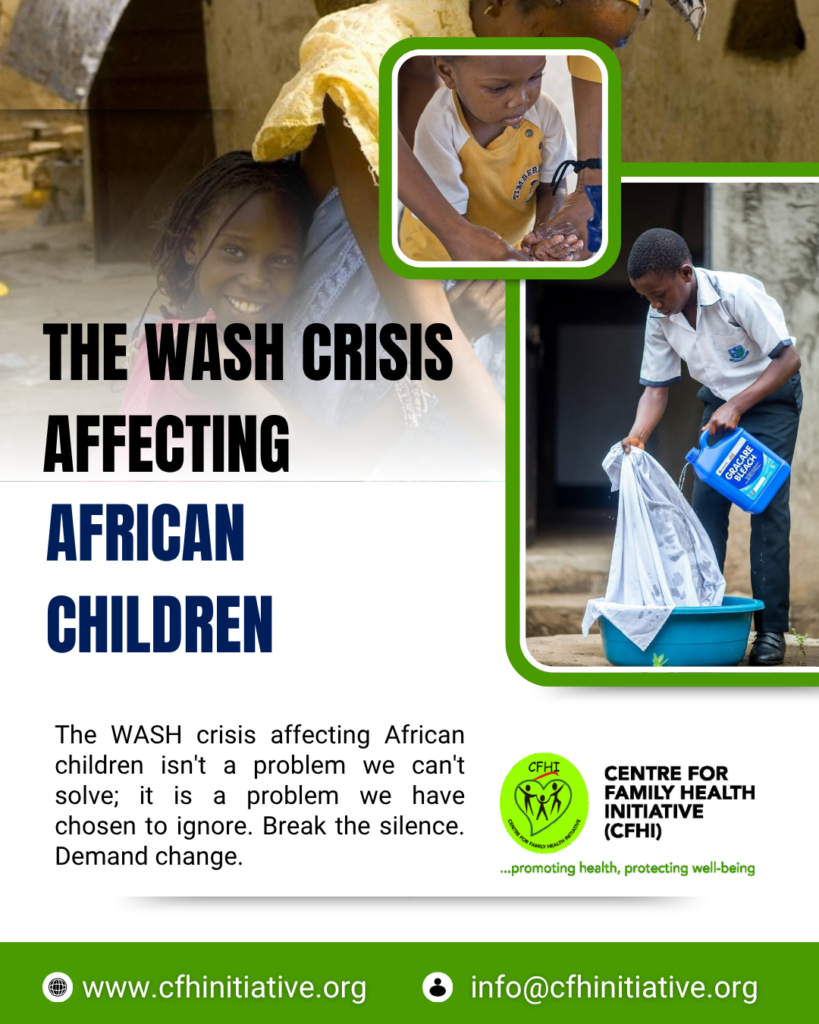
Access to clean water, safe sanitation, and proper hygiene collectively known as Water, Sanitation, and Hygiene (WASH) is not a luxury but a fundamental human right. Yet, for millions of children across Africa, this right remains unfulfilled. Every day, children are exposed to contaminated water, poor sanitation facilities, and inadequate hygiene conditions that threaten their health, education, dignity, and future. The WASH crisis is one of Africa’s most pressing public health challenges, silently contributing to preventable diseases, malnutrition, school absenteeism, and child mortality.
According to the WHO/UNICEF Joint Monitoring Programme (JMP), an estimated 2.1 billion people worldwide still lack access to safely managed drinking water, while 3.4 billion people do not have safely managed sanitation services. Furthermore, 1.7 billion people are unable to wash their hands with soap and water at home because they lack basic handwashing facilities (1). The burden of this crisis falls disproportionately on low- and middle-income countries, with sub-Saharan Africa recording some of the lowest levels of access to safe WASH services.
For African children, the consequences are severe. UNICEF estimates that 190 million children in ten African countries face a dangerous combination of water scarcity, unsafe drinking water, poor sanitation, climate-related shocks, and recurring disease outbreaks (2).
One of the most devastating consequences of poor WASH is the high prevalence of diarrhoeal diseases. According to the World Health Organization, diarrhoea remains one of the leading causes of death among children under five years of age, claiming approximately 443,000 young lives every year worldwide. More importantly, WHO estimates that 58% of diarrhoeal diseases are directly linked to unsafe water, poor sanitation, and inadequate hygiene (3). These are illnesses that can largely be prevented through access to clean water, improved sanitation, and proper hygiene practices.
The health effects extend far beyond diarrhoea. Poor WASH conditions increase the spread of cholera, typhoid fever, dysentery, hepatitis A, intestinal worm infections, trachoma, and several neglected tropical diseases. Children suffering from repeated infections often experience dehydration, nutrient loss, weakened immunity, and chronic undernutrition. Studies have shown that repeated episodes of diarrhoea significantly contribute to stunting, a condition that affects both physical growth and brain development, reducing children’s cognitive abilities and limiting their educational achievement and future productivity (4).
The recent cholera outbreaks across Africa further illustrate the urgency of the situation. Between January 2024 and March 2025, countries in Eastern and Southern Africa reported more than 178,000 cholera cases and nearly 2,900 deaths, with children among the most vulnerable groups (5). Cholera spreads rapidly in communities where access to clean water and sanitation is limited, highlighting the direct relationship between inadequate WASH infrastructure and disease outbreaks.
The WASH crisis also affects children’s education. Millions of African children miss school because they are sick from waterborne diseases or because they spend hours each day fetching water for their families. UNICEF reports that girls are particularly affected. Many adolescent girls skip classes or drop out of school due to the absence of private, clean, and functional toilets and inadequate menstrual hygiene facilities. This not only affects academic performance but also perpetuates gender inequality and limits future opportunities (6).
Fortunately, investing in WASH produces remarkable health and economic returns. According to WHO, every US$1 invested in water and sanitation generates an estimated US$4.30 in economic returns through reduced healthcare costs, improved productivity, and fewer lost school and workdays (7). Communities with improved WASH services experience fewer disease outbreaks, lower child mortality, better nutrition, higher school attendance, improved maternal health, and stronger resilience during public health emergencies.
Ensuring every child has access to safe water, sanitation, and hygiene requires coordinated efforts from governments, development partners, communities, schools, parents, and civil society. Governments should prioritize investments in safe water supply systems, sanitation infrastructure, and hygiene promotion, particularly in rural and underserved communities. Development partners and civil society organizations should continue supporting innovative WASH programmes that expand access to safe water and sanitation services for vulnerable populations.
Schools should provide safe drinking water, gender-friendly toilets, handwashing stations with soap, and age-appropriate hygiene education. Government and Communities have a vital responsibility to protect local water sources by discouraging open defecation, promoting proper waste disposal, and preventing environmental contamination. Parents also play an important role by teaching children healthy hygiene practices from an early age and ensuring safe water storage and handling at home.
Access to safe water and sanitation should never depend on where a child is born or the income of their family. Ensuring universal access to WASH is not only essential for improving health but also for reducing poverty, promoting education, advancing gender equality, and achieving sustainable development across Africa.
Monday Health Burst is an initiative of CFHI to address issues of basic health concern. Join us every Monday on all our social media platforms for more episodes.
References
- WHO & UNICEF Joint Monitoring Programme (JMP): https://washdata.org
- UNICEF – Water Security and Climate Crisis in Africa: https://www.unicef.org
- WHO – Drinking Water Fact Sheet: https://www.who.int/news-room/fact-sheets/detail/drinking-water
- UNICEF – Water, Sanitation and Hygiene Programme: https://www.unicef.org/wash
- UNICEF Eastern and Southern Africa – Cholera Situation Updates: https://www.unicef.org/esa
- UNESCO – Water, Sanitation, Hygiene and Education: https://www.unesco.org
- WHO – Global Analysis and Assessment of Sanitation and Drinking Water (GLAAS): https://www.who.int/teams/environment-climate-change-and-health/water-sanitation-and-health
Great content! Keep up the good work!
Thank you so much, we really appreciate you kind words