For millions of Nigerians, the Primary Healthcare Centre (PHC) is the closest and sometimes the only place where they can receive medical care. Yet, despite serving as the foundation of Nigeria’s healthcare system, many Primary Healthcare Centres remain underfunded, understaffed, poorly equipped, or inaccessible, leaving millions of people without the quality healthcare they deserve.
Primary healthcare is the first level of contact between individuals and the health system. According to the World Health Organization (WHO), it provides comprehensive healthcare services that meet between 80 and 90 percent of an individual’s essential health needs throughout their lifetime (1). These services include health promotion, disease prevention, diagnosis, treatment, rehabilitation, palliative care, maternal and child healthcare, immunization, nutrition services, family planning, HIV and tuberculosis services, mental healthcare, and health education. By bringing these essential services closer to where people live, primary healthcare ensures that healthcare is accessible, affordable, and equitable.
Nigeria has over 30,000 Primary Healthcare Centres distributed across its 774 Local Government Areas (5,7). However, reports from the Federal Ministry of Health indicate that only a fraction of these facilities consistently provide comprehensive, quality services because many lack adequate infrastructure, electricity, clean water, medical equipment, essential medicines, and sufficient healthcare personnel (5). In some rural communities, residents travel several kilometres to reach the nearest functional health facility, often delaying treatment until illnesses become severe.
One of the greatest strengths of primary healthcare is its focus on prevention. Early diagnosis and timely treatment improve health outcomes while reducing the financial burden on families and the healthcare system. Preventive healthcare has consistently been shown to be far more cost-effective than managing advanced diseases that require hospitalization and specialized care (1,6).
Primary healthcare is also essential for improving maternal and child health. Nigeria accounts for one of the highest burdens of maternal and child mortality globally. According to the United Nations Maternal Mortality Estimation Inter-Agency Group, Nigeria recorded approximately 1,047 maternal deaths per 100,000 live births in 2020, one of the highest maternal mortality ratios in the world (3). In addition, UNICEF reports that millions of Nigerian children still miss essential vaccines each year, making the country one of the largest contributors to the global number of “zero-dose” children – those who have not received even a single routine vaccine (4).
Primary healthcare also plays a central role in controlling infectious diseases. According to the World Malaria Report 2024, Nigeria accounts for approximately 27 percent of all global malaria cases and about 31 percent of malaria-related deaths worldwide (2). The diagnosis, treatment, prevention, and distribution of insecticide-treated mosquito nets are largely coordinated through primary healthcare facilities. Strengthening these facilities directly contributes to reducing malaria-related illness and deaths.
Beyond routine healthcare, Primary healthcare Centres serve as the country’s first line of defence during disease outbreaks and public health emergencies. Whether responding to cholera outbreaks, Lassa fever, meningitis, COVID-19, or emerging infectious diseases, Primary Healthcare Centres play a central role in disease surveillance, case detection, public awareness, vaccination campaigns, contact tracing, and referrals (1,5). Community health workers are often the first professionals to identify unusual disease patterns and alert public health authorities before outbreaks escalate.
Investing in primary healthcare also makes economic sense. The World Bank estimates that investments in primary healthcare generate substantial economic returns because preventing illness costs significantly less than treating advanced disease (6). When affordable healthcare is available within communities, families are less likely to experience catastrophic health expenditures that push them deeper into poverty when affordable healthcare is available within their communities.
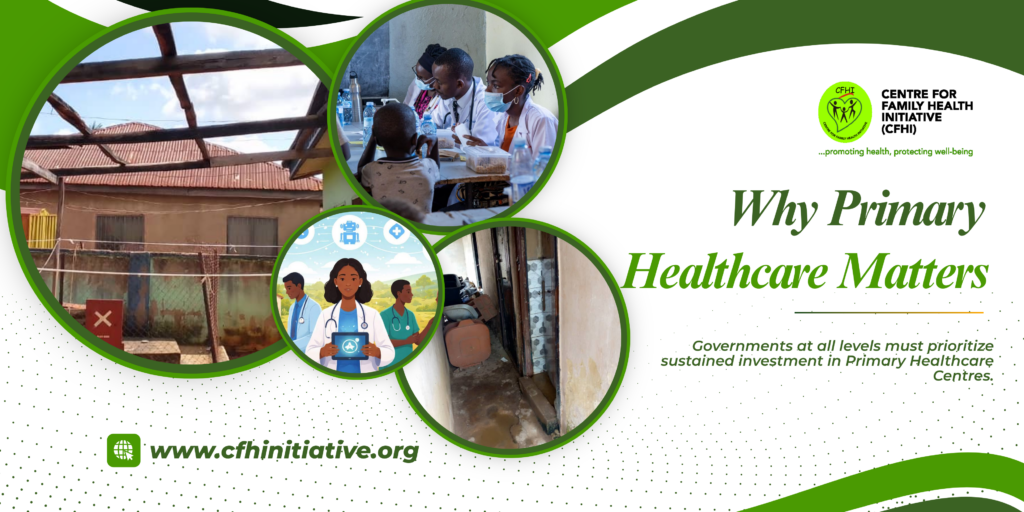
Unfortunately, many Nigerian communities continue to experience the consequences of weak primary healthcare systems (5,7). Health centres without skilled personnel, essential medicines, functional laboratories, ambulances, reliable electricity, clean water, or adequate medical equipment cannot provide quality services. Patients are often referred unnecessarily to already overcrowded secondary and tertiary hospitals, increasing waiting times, treatment costs, and avoidable deaths. Pregnant women may be forced to deliver at home or travel long distances while in labour. Children may miss life-saving immunizations because vaccines are unavailable or cold-chain equipment is non-functional.
The consequences extend beyond health. Weak primary healthcare reduces workforce productivity, increases school absenteeism, places greater financial pressure on households, and perpetuates poverty. Ultimately, no nation can achieve sustainable development without a strong and accessible primary healthcare system, because the health of its people is fundamental to its social and economic progress (6).
Governments at all levels must prioritize sustained investment in Primary Healthcare Centres. Strengthening primary healthcare is not merely a health sector priority, it is an investment in Nigeria’s future. It is the foundation upon which healthier families, stronger communities, and prosperous nations are built.
Every Nigerian, regardless of where they live or their socio-economic status, deserves access to a well-equipped Primary Healthcare Centre capable of delivering safe, timely, and quality healthcare.
References
1. World Health Organization (WHO). Primary Health Care. Geneva: WHO; 2024. Available from: https://www.who.int/health-topics/primary-health-care
2. World Health Organization. World Malaria Report 2024. Geneva: WHO; 2024.
3. United Nations Maternal Mortality Estimation Inter-Agency Group. Trends in Maternal Mortality: 2000–2020. New York: United Nations; 2023.
4. UNICEF Nigeria. Immunization and Zero-Dose Children in Nigeria. Abuja: UNICEF Nigeria.
5. Federal Ministry of Health and Social Welfare. Nigeria Health Sector Renewal Investment Initiative. Abuja: Federal Government of Nigeria.
6. World Bank. Primary Health Care and Universal Health Coverage. Washington, DC: World Bank.
7. National Primary Health Care Development Agency (NPHCDA). Primary Health Care Under One Roof (PHCUOR) Policy. Abuja: NPHCDA.