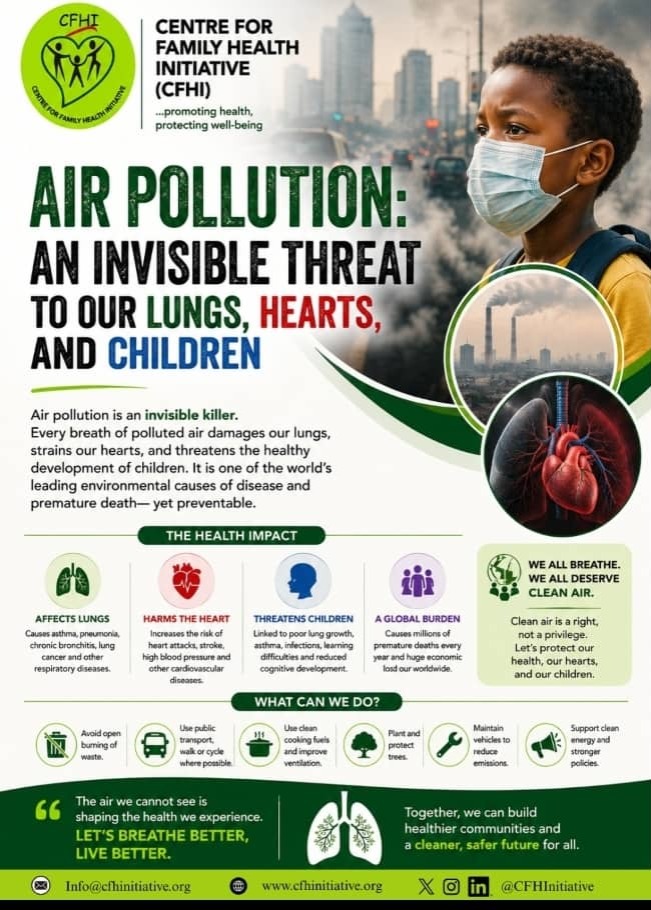
Every breath we take should sustain life, yet billions of people inhale polluted air that silently harms their health. Unlike contaminated food or water, air pollution is often invisible, making it one of the world’s most dangerous environmental health threats. According to the World Health Organization (WHO), air pollution contributes to approximately 6.7 million premature deaths each year, making it a leading cause of disease and death globally. ¹
Air pollution consists of harmful substances such as fine particulate matter (PM₂.₅), nitrogen dioxide, sulfur dioxide, ozone, carbon monoxide, and other toxic pollutants released from vehicles, industries, power plants, open waste burning, household cooking fuels, and natural events like wildfires.² Fine particulate matter (PM₂.₅) is especially dangerous because it penetrates deep into the lungs and enters the bloodstream, affecting nearly every organ in the body.³ Today, about 99% of the world’s population breathes air that fails to meet WHO air quality standards. ¹
The lungs are the first organs affected. Long-term exposure to polluted air increases the risk of asthma, chronic obstructive pulmonary disease (COPD), pneumonia, chronic bronchitis, lung cancer, and frequent respiratory infections.⁴ Persistent coughing, wheezing, chest tightness, and shortness of breath are common among people living in highly polluted environments.
Air pollution also damages the heart. Fine particles entering the bloodstream cause inflammation, raise blood pressure, damage blood vessels, and increase the risk of heart attacks, strokes, heart failure, and other cardiovascular diseases. Research consistently shows that prolonged exposure to PM₂.₅ significantly increases cardiovascular risk, even among people without traditional risk factors. ³
Children are among the most vulnerable. Because their lungs and immune systems are still developing, they breathe more polluted air relative to their body weight than adults. Exposure before and after birth has been linked to premature birth, low birth weight, asthma, pneumonia, impaired lung development, and reduced cognitive performance.⁶ UNICEF estimates that nearly 500,000 children under five die from pneumonia each year, with air pollution being a major contributing factor.⁶
Beyond its health effects, air pollution places enormous pressure on healthcare systems and national economies through increased medical costs, reduced productivity, and premature deaths⁸
The good news is that air pollution is largely preventable. Governments can strengthen air quality regulations, promote clean energy, improve public transportation, and reduce industrial emissions. Individuals can also help by avoiding open burning, maintaining vehicles, conserving energy, planting trees, and supporting cleaner technologies.
Clean air is not a luxury—it is a fundamental human right. Protecting air quality will save lives, safeguard children’s futures, reduce heart and lung diseases, and create healthier communities for generations to come.
References
1. World Health Organization. Ambient (outdoor) air pollution. Available at: https://www.who.int/news-room/fact-sheets/detail/ambient-(outdoor)-air-quality-and-health
2. World Health Organization. Air pollution. Available at: https://www.who.int/health-topics/air-pollution
3. World Health Organization. WHO Global Air Quality Guidelines. Available at: https://www.who.int/publications/i/item/9789240034228
4. International Agency for Research on Cancer (IARC). Outdoor Air Pollution. Available at: https://www.iarc.who.int/cancer-type/outdoor-air-pollution
5. World Health Organization. Cardiovascular diseases (CVDs). Available at: https://www.who.int/news-room/fact-sheets/detail/cardiovascular-diseases-(cvds)
6. UNICEF & World Health Organization. Air Pollution and Child Health: Prescribing Clean Air. Available at: https://www.unicef.org/reports/air-pollution-child-health-prescribing-clean-air
7. World Health Organization. Household air pollution and health. Available at: https://www.who.int/news-room/fact-sheets/detail/household-air-pollution-and-health
8. World Bank. The Global Health Cost of PM2.5 Air Pollution. Available at: https://www.worldbank.org/en/topic/pollution