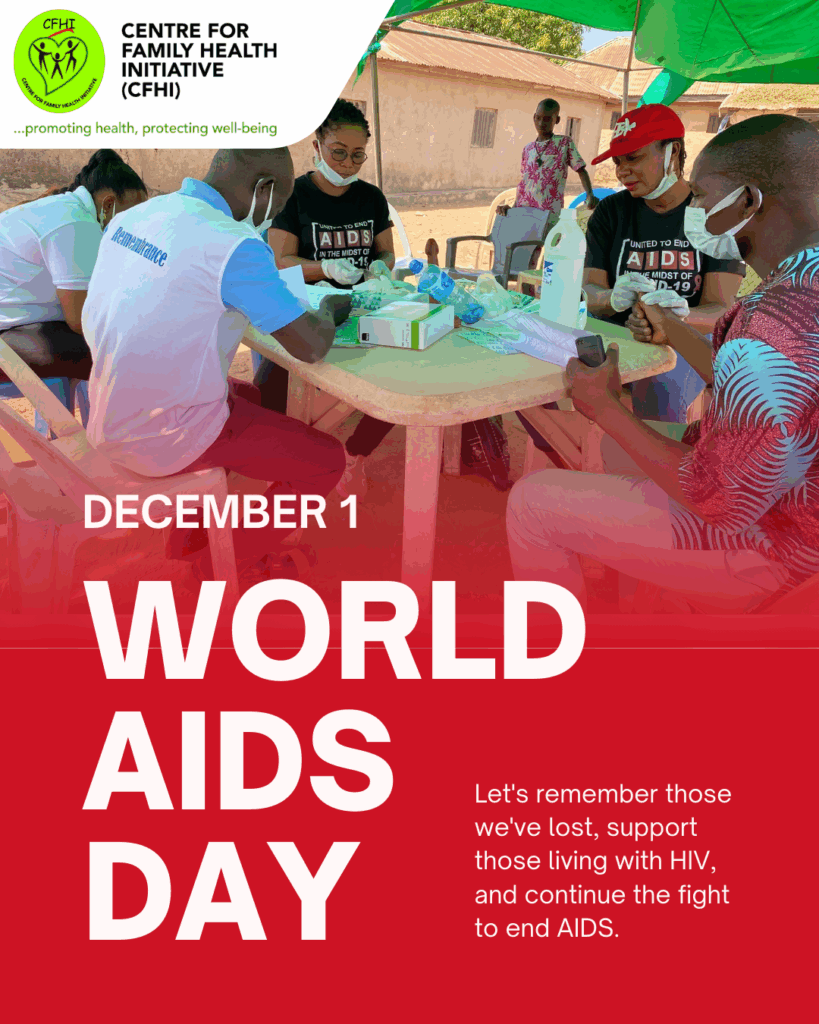
Today, December 1st, the world once again marks World AIDS Day, a global reminder of our shared responsibility to end HIV and support people living with it. This year’s theme, “Overcoming Disruption, Transforming the AIDS Response,” highlights the urgent need to rebuild stronger, more resilient, and equitable systems that ensure no one is left behind in HIV prevention and care [1]. Despite decades of progress, HIV continues to thrive where misinformation, stigma, poverty, and limited access to health services persist, especially among vulnerable groups such as adolescents, young women, and key populations [2].
Understanding how HIV spreads remains essential. The virus is transmitted through unprotected sexual intercourse, sharing contaminated needles, mother-to-child transmission during pregnancy, birth, or breastfeeding, and rarely through unscreened blood transfusion [3]. It is important to emphasize that HIV cannot be transmitted through casual contact, which means stigma rooted in misinformation must continue to be challenged [4]. Prevention remains powerful when individuals consistently use condoms, access regular HIV testing, utilize PrEP when at risk, avoid sharing needles, and ensure pregnant women living with HIV receive PMTCT services [5]. Effective treatment such as antiretroviral therapy suppresses viral load, making HIV untransmittable when undetectable (U=U), a breakthrough in global HIV care [6].
The Centre for Family Health Initiative (CFHI) remains committed to strengthening the HIV response through coordinated community engagements that include HIV testing, counselling, prevention education, PMTCT support, stigma reduction activities, and linkage to care for individuals and families. Over the years, CFHI has collaborated with partners such as Excellence and Friends Management Care Centre (EFMC), the Catholic Caritas Foundation of Nigeria (CCFN), and the Institute of Human Virology Nigeria (IHVN). These partnerships have supported CFHI in reaching over 14,000 children and caregivers with essential HIV-related services. Currently, CFHI continues to work actively with IHVN alongside support from the FCT Social Development Secretariat (SDS) to provide ongoing care, and treatment adherence services to about 6,000 children and their caregivers. Through its OVC programming, CFHI remains committed to improving long-term health, resilience, and stability for vulnerable families affected by HIV.
As Nigeria joins the global community in commemorating World AIDS Day 2025, it is essential for the government to strengthen its leadership in the national HIV response. This includes increasing investment in public health systems, ensuring consistent availability of testing kits and antiretroviral medications, expanding prevention programs such as PrEP and PMTCT, and improving data management for timely decision-making. Government action is also needed to address stigma through nationwide awareness campaigns, to support state-level implementation of HIV programs, and to create enabling environments where community organizations, healthcare workers, and development partners can scale interventions effectively. HIV is preventable and treatable, and with informed choices, prioritizing equitable access to services, sustaining political commitment, and collective action, Nigeria can accelerate progress toward ending AIDS as a public health threat.
Everyone is encouraged to take responsibility by getting tested, reducing risk, supporting those living with HIV, and rejecting stigma in every form.
References
- World Health Organization. World AIDS Day 2025 Theme: Overcoming Disruption, Transforming the AIDS Response. Geneva: WHO; 2025. https://www.who.int
- UNAIDS. Global HIV & AIDS Statistics — Fact Sheet 2025. Joint United Nations Programme on HIV/AIDS; 2025. https://www.unaids.org/en/resources/fact-sheet
- Centers for Disease Control and Prevention. HIV Transmission Overview. Atlanta: CDC; 2024. https://www.cdc.gov/hiv/basics/transmission.html
- UNAIDS. Confronting HIV Stigma and Discrimination. Joint United Nations Programme on HIV/AIDS; 2024. https://www.unaids.org/en/key-programmes/stigma-discrimination
- World Health Organization. HIV Prevention Guidelines. Geneva: WHO; 2024. https://www.who.int/health-topics/hiv
- UNAIDS. Undetectable = Untransmittable (U=U) Scientific Update. Geneva: UNAIDS; 2024. https://www.unaids.org/en/resources/presscentre/featurestories/2024/u-u
- Centre for Family Health Initiative. Community HIV Services and OVC Support Report. Abuja: CFHI; 2024. https://www.cfhinitiative.org