Access to quality healthcare is recognized globally as a fundamental human right. Yet, billions of people still cannot exercise this right. Recent WHO and UNICEF estimates, about 1.1 billion people received healthcare in facilities without basic water services, while 3.0 billion lacked access to sanitation services, creating unsafe environments for patients and health workers alike (1). Additionally, 1.7 billion individuals were cared for in facilities without proper hygiene standards, and about 2.8 billion lacked access to safe health-care waste management, exposing communities to preventable infections (1). Another WHO report highlights that nearly one billion people depend on facilities with unreliable or no electricity, making safe childbirth, emergency care, vaccine storage, and laboratory services extremely difficult (2). To address such challenges, CFHI, with support from Grand Challenges Nigeria, recently installed solar birth kits at Rumde PHCC in Adamawa and Gusau PHCC in Zamfara States. These kits provide reliable solar-powered lighting, enabling skilled birth attendants to conduct deliveries safely at night or during power outages, support emergency care, and ensure essential medical equipment can function consistently.
Such deficits represent clear violations of the right to health. Quality healthcare must be safe, clean, affordable, and accessible. Studies further show that poor healthcare access contributes to increased maternal mortality, preventable illnesses among children, late health-seeking behaviour, and financial hardship. Globally, millions face catastrophic out-of-pocket spending on healthcare, pushing vulnerable families into poverty each year (3). Universal Health Coverage frameworks emphasize equity; however, implementation remains slow in many developing countries, especially in rural and underserved communities where health investment is still low.
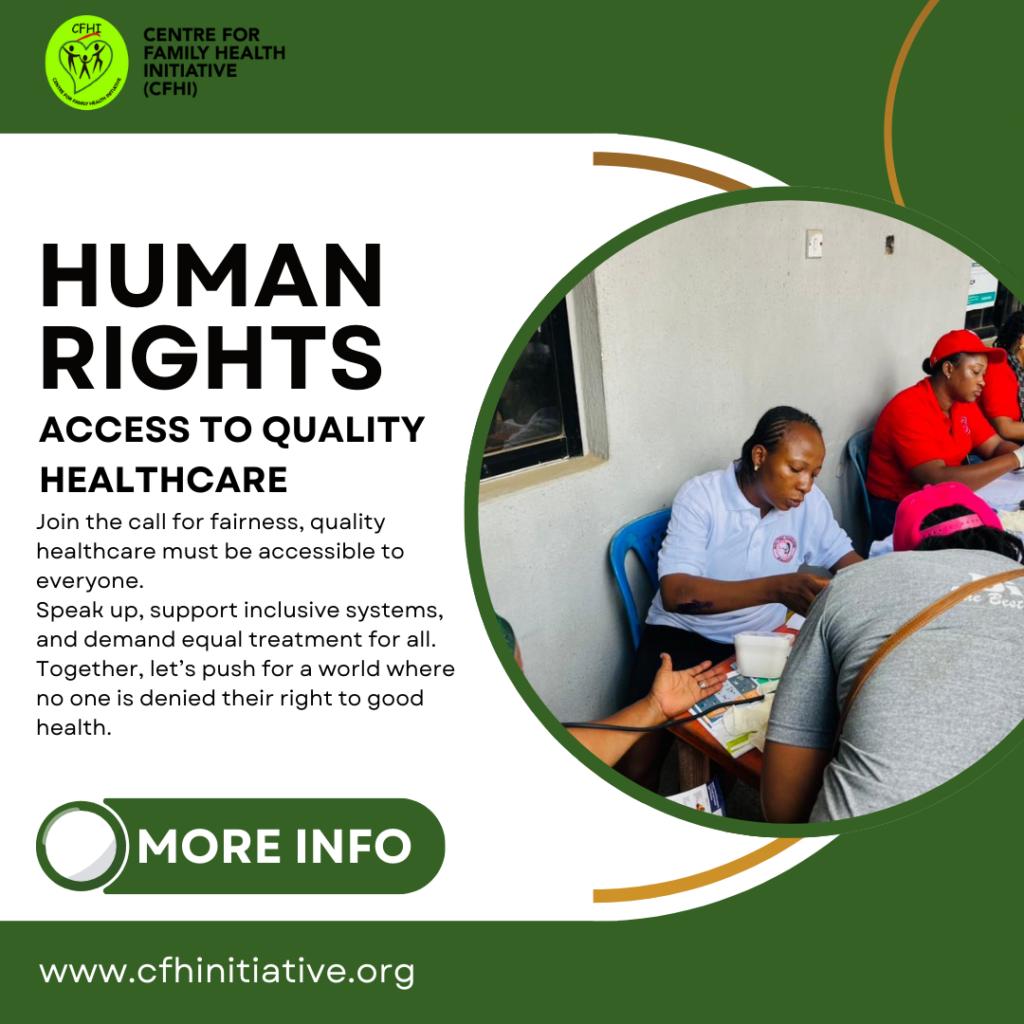
In Nigeria, although relevant health policies exist, many communities still lack the enabling environment to exercise their health rights, the government has the primary responsibility to provide healthcare services and maintain facilities, the reality is that many health centres remain dilapidated and under-resourced. This situation underscores the urgent need for authorities to prioritize investment in health infrastructure, provide functional equipment, and ensure every facility meets minimum standards to protect the lives of mothers, newborns, and communities. This is where organizations such as Centre for Family Health Initiative (CFHI) contribute meaningfully to bridging the gap. CFHI works to expand equitable healthcare access by implementing interventions that support orphans and vulnerable children, adolescents, caregivers, and low-income households. The organization improves community knowledge on health rights, offers psychosocial support, conducts HIV counselling, testing, and referrals, and assists vulnerable families in navigating access to healthcare facilities (4).
Through capacity building for healthcare workers, stronger health facility linkage, and participatory learning sessions, CFHI promotes informed decision-making and encourages service utilization which are critical elements of health rights implementation. Ultimately, improved health outcomes must go beyond policy frameworks; communities must receive accessible services delivered in dignity, and families must be able to seek care without financial ruin.
Achieving true universal access requires investment in basic facility infrastructure, elimination of discriminatory practices, improved health financing, and strengthened accountability mechanisms. When communities are assured of safety, fairness, and affordability, healthcare becomes a right in practice not merely in principle.
References
- World Health Organization and UNICEF. Countries making unprecedented efforts but billions still lack basic services in health-care facilities. WHO website. Available at: https://www.who.int/news/item/24-09-2025-countries-making-unprecedented-efforts-but-billions-still-lack-basic-services-in-health-care-facilities—who-unicef-new-report-warns
- World Health Organization. Global progress report on universal access to WASH services in healthcare facilities. WHO website. Available at: https://www.who.int/news/item/24-09-2025-countries-making-unprecedented-efforts-but-billions-still-lack-basic-services-in-health-care-facilities—who-unicef-new-report-warns
- World Bank Group. Billions left behind on the path to universal health coverage. World Bank website. Available at: https://www.worldbank.org/en/news/press-release/2023/09/18/billions-left-behind-on-the-path-to-universal-health-coverage
- Centre for Family Health Initiative (CFHI). Programme information and reports. CFHI website. Available at: https://www.cfhinitiative.org