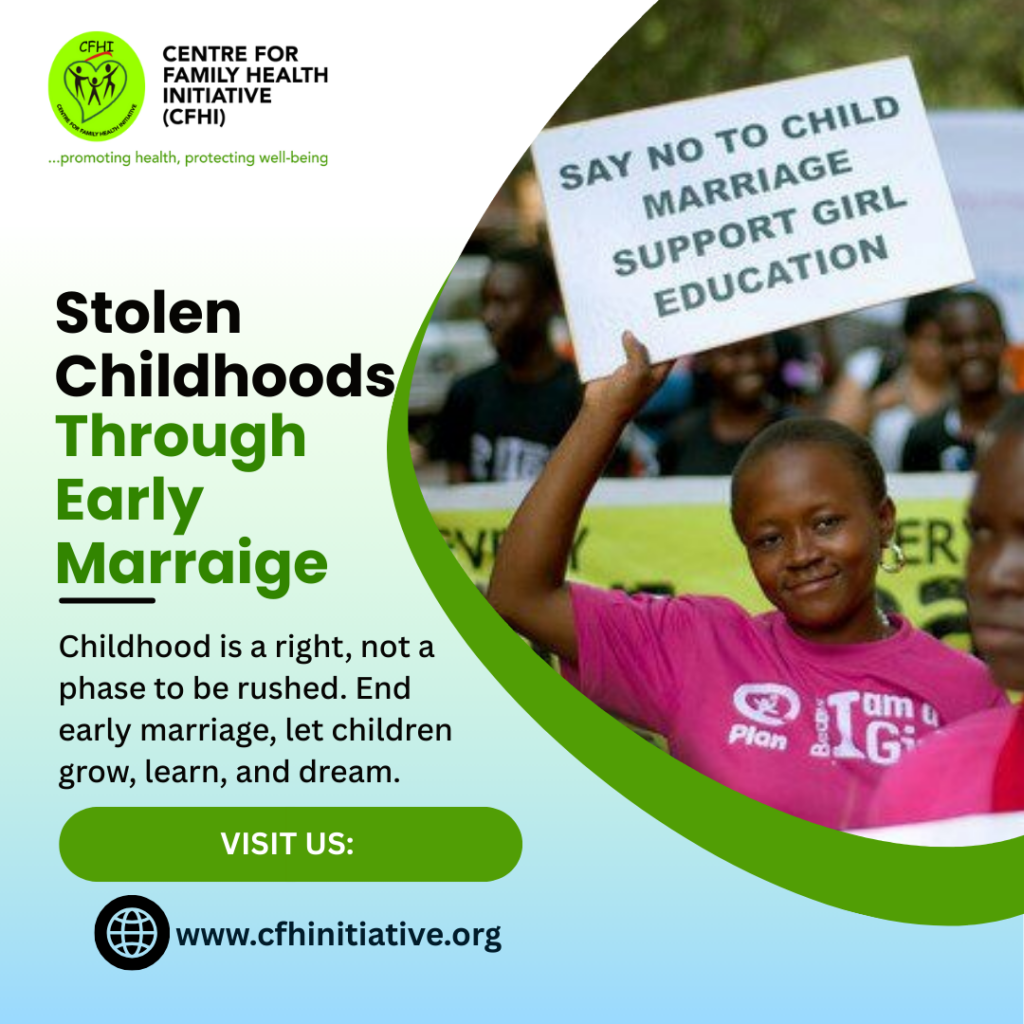
Child marriage, also known as early marriage, refers to any formal marriage or informal union where one or both partners are under the age of 18. Despite laws and global commitments to end this practice, it remains widespread and continues to rob millions of children especially girls of their childhoods, education, health, and future opportunities. Globally, one in five young women aged 20–24 was married before age 18, compared to one in four a decade ago, showing slow progress but not enough to meet international targets. ¹
Every year, about 12 million adolescent girls are married before the age of 18, which translates to roughly 23 girls every minute entering unwanted, early partnerships.² This practice is not evenly distributed; it is more common in low- and middle-income countries, particularly in sub-Saharan Africa, where up to 41% of girls marry before 18, and in South Asia0ttwd- .³ Nigeria, for example, has one of the highest rates of child marriage in the world: an estimated 44% of girls are married before the age of 18, although recent reports indicate this may be declining nationally to around 30% as efforts to address the issue increase.⁴
The consequences of early marriage are profound. Girls who marry as children are far more likely to drop out of school, which severely limits their future economic opportunities and perpetuates cycles of poverty and dependency. Early marriage also exposes girls to higher risks of intimate partner violence, early and risky pregnancies, maternal health complications, and poor mental health outcomes. ⁵ Research shows that child brides experience worse health and social outcomes than their unmarried peers, and these effects often extend to their own children, undermining intergenerational well-being. ⁶
The prevalence of child marriage is influenced by multiple factors including poverty, lack of education, gender inequality, social norms, and in some regions, insecurity, and conflict. Data from Nigeria’s northern regions where poverty is high and educational outcomes are low shows early marriage remains particularly entrenched, with cultural practices and limited access to schooling contributing to higher rates. ⁷ The COVID-19 pandemic and other crises have also exacerbated these risks, as school closures, economic stress, and reduced social protections have increased vulnerability to early marriage in many communities. ⁸
Efforts to reduce child marriage require a multifaceted approach. Policies and laws that set the minimum age of marriage at 18 without exceptions must be enforced; girls’ access to quality education and economic opportunities must be expanded; and communities must be engaged to shift harmful norms that condone child marriage. Programs that empower adolescent girls with information, skills, and social support have been shown to delay marriage and improve life outcomes. International commitments, such as the Sustainable Development Goal target to eliminate child marriage by 2030, emphasize the importance of sustained action, yet projections suggest that without accelerated progress, child marriage will continue for decades in many countries. ⁹
Efforts by governments, civil society, families, and communities are essential to protect children and uphold their rights. Ending early marriage is not only a matter of legal compliance, but a moral imperative to ensure that every child can grow, learn, and contribute to society as an empowered adult.
Speak Wednesday is an initiative of CFHI to address issues around gender-base violence and gender-bias.
References
- UNICEF. Child marriage prevalence and trends (global). https://www.unicef.org/protection/child-marriage (UNICEF USA)
- UNICEF Innocenti. What works to prevent child marriage. https://www.unicef.org/innocenti/innocenti/innocenti/what-works-prevent-child-marriage (unicef.org)
- UNICEF West and Central Africa. Child marriage in West and Central Africa. https://www.unicef.org/wca/child-marriage (unicef.org)
- UNICEF Nigeria. Child marriage rates and trends in Nigeria. https://www.unicef.org/nigeria/press-releases/nigeria-takes-bold-steps-end-child-marriage-and-protect-rights-children (unicef.org)
- Prevention Collaborative. Child, early, and forced marriage harms and impacts. https://prevention-collaborative.org/about-violence/child-early-and-forced-marriage/ (Prevention Collaborative)
- PubMed systematic review. Prevalence and factors associated with child marriage. https://pubmed.ncbi.nlm.nih.gov/37817117/ (PubMed)
- International Health (Oxford Academic). Spatial distribution of child marriage in Nigeria. https://academic.oup.com/inthealth/article/15/2/171/6589585 (OUP Academic)
- Early marriage and teenage pregnancy literature review (COVID-19 impacts). https://pmc.ncbi.nlm.nih.gov/articles/PMC8411836/ (PMC)
- UNFPA / UNICEF global programme and SDG targets. https://www.unfpa.org/child-marriage (unfpa.org)