Across the world, harmful practices such as female genital mutilation (FGM) and child marriage continue to violate the rights, health, and futures of millions of girls and young women, often entrenched in patriarchal norms and social pressures. UNICEF estimates that at least 230 million girls and women alive today have undergone FGM, and over 12 million girls are married before age 18 every year, both of which are rooted in gender inequality and harmful social norms upheld at the family and community level. These practices not only harm physical and psychological wellbeing but also constrain girls’ access to education, livelihoods, and basic human rights. (UNICEF)
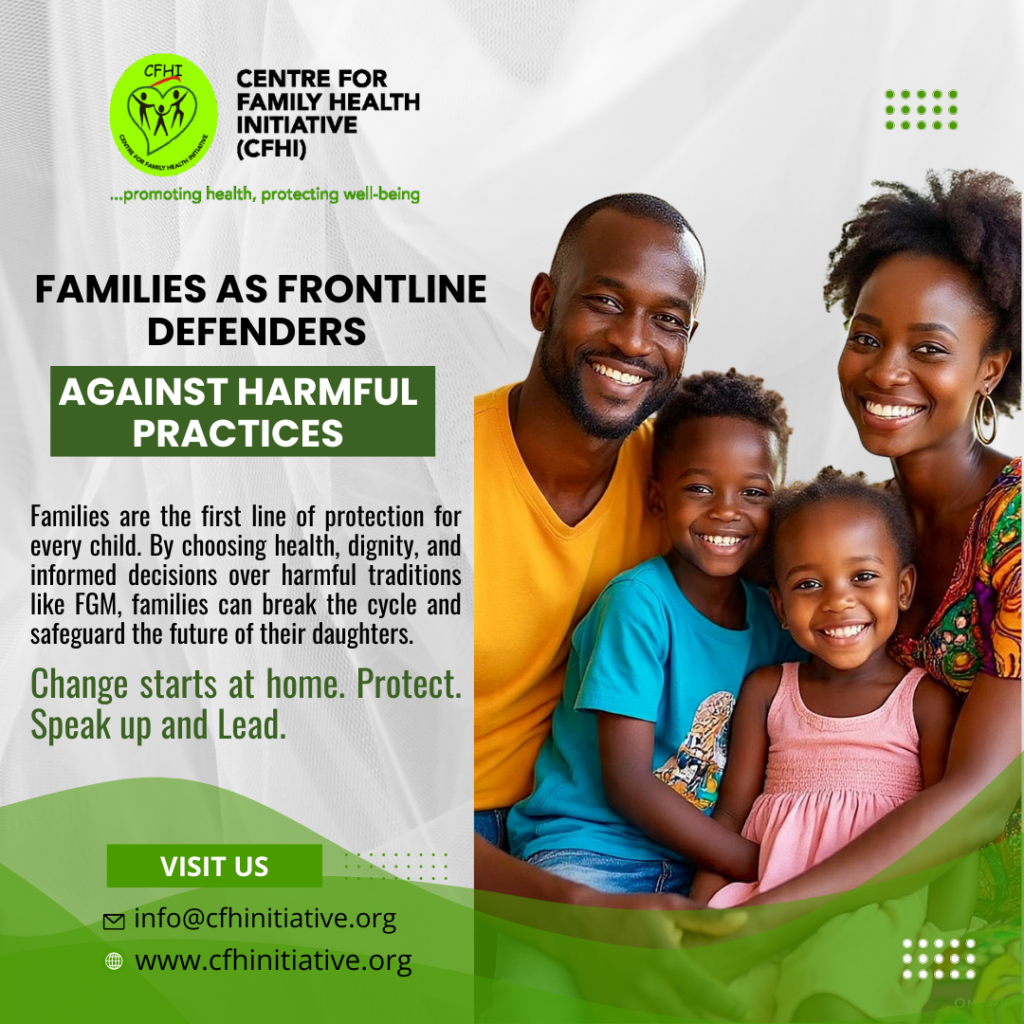
Families are not merely passive bystanders in this landscape they can be frontline defenders against harmful practices. Research shows that families influence health behavior, decision-making, and wellbeing from early life through adolescence and adulthood, making them invaluable actors in preventing and countering abuse and discrimination. Family-oriented health promotion strategies have been found to be effective in reducing child maltreatment and strengthening protective factors by enhancing parenting practices, social support, and overall family wellbeing. (PubMed)
In many communities where harmful practices like FGM and child marriage persist, decision making often occurs within the household, with parents, extended family members, and elders shaping whether girls are subjected to such rites. In parts of sub-Saharan Africa, families fear social ostracism and harm to a girl’s “marriage prospects” if she is not cut or married early beliefs that are enforced by elders and community expectations. This social pressure persists even where awareness of harm is increasing, illustrating how deeply family influence and social norms are intertwined. (acrl-rfp.org) In Mali, for example, prevalence rates of FGM remain high only dropping from 91% to 89% over two decades underscoring that legal change alone is insufficient without deep shifts in family and community norms. (ODI: Think change)
However, when families act as agents of change rather than enforcers of harmful norms, progress is possible. In Sudan in 2025, community committees that included family members mobilized against an FGM practitioner’s arrival, stopping the practice in its tracks, and demonstrating the power of collective family and community action to protect children. This local action, grounded in awareness about health risks and legal protections, helped shift attitudes and strengthen community resistance against harmful practices. (UNICEF)
Education is another critical lever. Families that value girls’ schooling and future potential are more likely to delay or abandon harmful practices, recognizing the long-term benefits of learning and opportunity. Research from UNICEF indicates that education can shift attitudes and reduce the transmission of harmful practices across generations, as families who understand the risks and benefits are better positioned to protect their daughters. (UNICEF DATA)
Promoting family engagement as a public health strategy also aligns with broader efforts to prevent violence and abuse. Evidence shows that family-based interventions reduce harmful behaviors such as bullying among children and adolescents by improving parenting, communication, and protective supervision. These family systems create environments where children feel supported, informed, and safer, reducing the likelihood of various forms of harm. (SpringerLink)
Yet meaningful change requires more than individual awareness it requires collective, sustained action that equips families with knowledge, resources, and support to challenge harmful norms. Governments, civil society, health systems, and community leaders must invest in education, legal protections, economic opportunities, and culturally appropriate outreach that reinforces families as protectors rather than perpetuators of harmful practices. As one advocate puts it, “Families who understand the suffering these practices cause is increasingly willing to resist, one conversation at a time.” (UNICEF)
Call to Action: Ending harmful practices such as FGM and child marriage depends on empowering families with evidence, support, and tools to reject harmful norms and champion girls’ rights. Invest in family-focused education and prevention, strengthen community support networks, involve elders and parents in advocacy, and ensure every girl’s health, education, and dignity are protected.
References
- UNICEF Innocenti – Ending Harmful Practices (child marriage, FGM):
https://www.unicef.org/innocenti/projects/ending-harmful-practices (turn0search9) - Family Resource Centers & child maltreatment prevention:
https://pubmed.ncbi.nlm.nih.gov/41365102/ (turn0search0) - Education as a force against harmful practices:
https://data.unicef.org/data-for-action/education-a-powerful-force-against-harmful-practices/ (turn0search4) - Family/elders influence on FGM norms:
https://odi.org/en/insights/are-grandmothers-the-key-to-shifting-social-norms-on-fgmc-and-child-marriage/ (turn0search2) - Community action to stop FGM in Sudan:
https://www.unicef.org/sudan/stories/breaking-cycle-female-genital-mutilation-and-child-marriage (turn0search17) - Social pressures and family roles in harmful practices:
https://acrl-rfp.org/wp-content/uploads/2025/10/Faith-Leaders-Toolkit-to-End-Harmful-Practices.pdf (turn0search35)