
#africanchildren

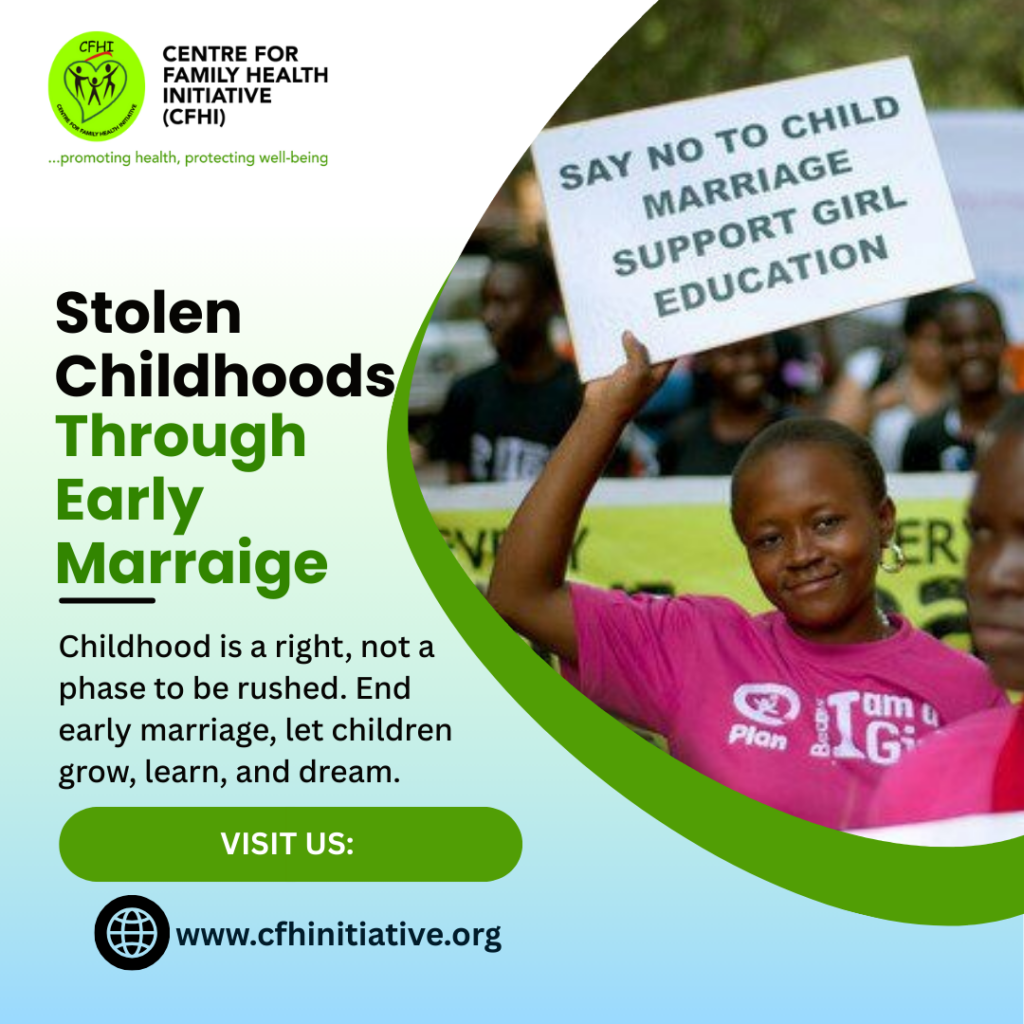
Stolen Childhoods Through Early Marriage

Child marriage, also known as early marriage, refers to any formal marriage or informal union where one or both partners are under the age of 18. Despite laws and global commitments to end this practice, it remains widespread and continues to rob millions of children especially girls of their childhoods, education, health, and future opportunities. Globally, one in five young women aged 20–24 was married before age 18, compared to one in four a decade ago, showing slow progress but not enough to meet international targets. ¹

Every year, about 12 million adolescent girls are married before the age of 18, which translates to roughly 23 girls every minute entering unwanted, early partnerships.² This practice is not evenly distributed; it is more common in low- and middle-income countries, particularly in sub-Saharan Africa, where up to 41% of girls marry before 18, and in South Asia0ttwd- .³ Nigeria, for example, has one of the highest rates of child marriage in the world: an estimated 44% of girls are married before the age of 18, although recent reports indicate this may be declining nationally to around 30% as efforts to address the issue increase.⁴

The consequences of early marriage are profound. Girls who marry as children are far more likely to drop out of school, which severely limits their future economic opportunities and perpetuates cycles of poverty and dependency. Early marriage also exposes girls to higher risks of intimate partner violence, early and risky pregnancies, maternal health complications, and poor mental health outcomes. ⁵ Research shows that child brides experience worse health and social outcomes than their unmarried peers, and these effects often extend to their own children, undermining intergenerational well-being. ⁶

The prevalence of child marriage is influenced by multiple factors including poverty, lack of education, gender inequality, social norms, and in some regions, insecurity, and conflict. Data from Nigeria’s northern regions where poverty is high and educational outcomes are low shows early marriage remains particularly entrenched, with cultural practices and limited access to schooling contributing to higher rates. ⁷ The COVID-19 pandemic and other crises have also exacerbated these risks, as school closures, economic stress, and reduced social protections have increased vulnerability to early marriage in many communities. ⁸

Efforts to reduce child marriage require a multifaceted approach. Policies and laws that set the minimum age of marriage at 18 without exceptions must be enforced; girls’ access to quality education and economic opportunities must be expanded; and communities must be engaged to shift harmful norms that condone child marriage. Programs that empower adolescent girls with information, skills, and social support have been shown to delay marriage and improve life outcomes. International commitments, such as the Sustainable Development Goal target to eliminate child marriage by 2030, emphasize the importance of sustained action, yet projections suggest that without accelerated progress, child marriage will continue for decades in many countries. ⁹

Efforts by governments, civil society, families, and communities are essential to protect children and uphold their rights. Ending early marriage is not only a matter of legal compliance, but a moral imperative to ensure that every child can grow, learn, and contribute to society as an empowered adult.

Speak Wednesday is an initiative of CFHI to address issues around gender-base violence and gender-bias.


References

  1. UNICEF. Child marriage prevalence and trends (global). https://www.unicef.org/protection/child-marriage (UNICEF USA)
  2. UNICEF Innocenti. What works to prevent child marriage. https://www.unicef.org/innocenti/innocenti/innocenti/what-works-prevent-child-marriage (unicef.org)
  3. UNICEF West and Central Africa. Child marriage in West and Central Africa. https://www.unicef.org/wca/child-marriage (unicef.org)
  4. UNICEF Nigeria. Child marriage rates and trends in Nigeria. https://www.unicef.org/nigeria/press-releases/nigeria-takes-bold-steps-end-child-marriage-and-protect-rights-children (unicef.org)
  5. Prevention Collaborative. Child, early, and forced marriage harms and impacts. https://prevention-collaborative.org/about-violence/child-early-and-forced-marriage/ (Prevention Collaborative)
  6. PubMed systematic review. Prevalence and factors associated with child marriage. https://pubmed.ncbi.nlm.nih.gov/37817117/ (PubMed)
  7. International Health (Oxford Academic). Spatial distribution of child marriage in Nigeria. https://academic.oup.com/inthealth/article/15/2/171/6589585 (OUP Academic)
  8. Early marriage and teenage pregnancy literature review (COVID-19 impacts). https://pmc.ncbi.nlm.nih.gov/articles/PMC8411836/ (PMC)
  9. UNFPA / UNICEF global programme and SDG targets. https://www.unfpa.org/child-marriage (unfpa.org)


Stolen Childhoods Through Early Marriage Read More »
Institutional Barriers to Eliminating Gender-Based Violence in Nigeria

Gender-Based Violence (GBV) remains one of the most pervasive human rights violations in Nigeria, cutting across age, class, religion, and region. Despite significant progress through policies such as the Violence Against Persons (Prohibition) Act (VAPP) 2015 and the National Gender Policy, the persistence of GBV points to a deeper problem institutional barriers that hinder real progress. While advocacy, awareness, and community engagement have improved over the years, the systems designed to protect survivors and hold perpetrators accountable often fail to function effectively, leaving many victims without justice or support (WHO, UN Women Nigeria).

One of the major institutional barriers lies within the legal and policy framework itself. Although the VAPP Act was enacted at the federal level, its domestication across Nigeria has been uneven. Several states are yet to fully implement the Act, creating inconsistencies in protection and enforcement. Even where laws exist, weak sanctions, unclear definitions of offences, and a lack of gender-sensitive judicial processes often discourage survivors from seeking justice. Studies reveal that institutional delays, corruption, and lack of trust in law enforcement agencies further compound the challenge, allowing perpetrators to act with impunity while survivors continue to suffer in silence (UNIZIK Journal of Contemporary Law).

Another critical issue is institutional capacity and accountability. Many key institutions from the police and judiciary to hospitals and social welfare departments are under-resourced and poorly coordinated. A BMC Women’s Health (2025) study found that more than half of young women surveyed in Nigeria reported not knowing where or how to access post-violence services, indicating major gaps in awareness and accessibility. Furthermore, the lack of training among personnel on survivor-centred approaches leads to secondary victimization, where victims experience stigma, judgment, or even blame when they report abuse. Without adequate funding, coordination, and monitoring systems, institutions cannot effectively carry out their mandates in the fight against GBV (PubMed).

Institutional culture also plays a silent but powerful role. In many organizations and workplaces, gender inequality is embedded in the structure itself from male-dominated leadership to discriminatory workplace practices. Research in Nigerian universities has shown a high prevalence of sexual harassment and bullying, often perpetuated by hierarchical power systems that silence victims (BMC Women’s Health, 2021). The absence of internal reporting mechanisms, confidentiality policies, and disciplinary structures reinforces a culture of impunity. When institutions themselves tolerate or ignore acts of violence, it sends a dangerous message that such behaviour is acceptable or can be overlooked.

Finally, the lack of effective data systems and poor inter-agency coordination weaken national response efforts. Many institutions fail to collect or share accurate data on GBV cases, making it difficult to track progress or design informed interventions. Without reliable evidence, resource allocation becomes arbitrary, and survivors remain invisible in policy decisions (MDPI Social Sciences Journal). These systemic weaknesses mean that even well-intentioned programs struggle to achieve lasting change.

The Centre for Family Health Initiative (CFHI) continues to advocate for institutional reforms that promote gender equality, justice, and survivor centred GBV response systems. Through its gender norms interventions and community engagement projects, CFHI works to sensitize service providers, law enforcement officers, and community leaders on the importance of implementing the VAPP Act effectively. The organization also conducts awareness campaigns under its SpeakWednesday platform to highlight barriers that hinder justice for survivors. By fostering collaboration between government agencies, CSOs, and communities, CFHI contributes to strengthening institutional frameworks that ensure women and girls live free from violence and discrimination.

Eliminating GBV in Nigeria requires more than awareness it demands institutional transformation. Laws must not only exist but be enforced; systems must not only respond but protect. As CFHI and partners continue to push for accountability and systemic change, a safer, more equitable Nigeria becomes achievable for all.

References

  1. Violence Against Persons (Prohibition) Act (VAPP) 2015. Policy Vault Africa. Available from: https://policyvault.africa/wp-content/uploads/policy/NGA1408.pdf
  2. Federal Ministry of Women Affairs. National Gender Policy. Available from: https://nigeriarising.org.ng/wp-content/uploads/2021/06/National-Gender-Policy.pdf
  3. World Health Organization (WHO). Violence against women. Available from: https://www.who.int/news-room/fact-sheets/detail/violence-against-women
  4. UN Women Nigeria. Gender-Based Violence in Nigeria: Review of Institutional Responses. Available from: https://nigeria.un.org/en/222675-gender-based-violence-nigeria-review-institutional-responses
  5. Ezeibe CC. The Challenges of Implementing the VAPP Act in Nigeria. UNIZIK Journal of Contemporary Law. Available from: https://journals.unizik.edu.ng/jcpl/article/download/6488/5405/14850
  6. BMC Women’s Health (2025). Institutional Barriers and Women’s Access to GBV Services in Nigeria. Available from: https://bmcwomenshealth.biomedcentral.com/articles/10.1186/s12905-025-03714-2
  7. PubMed Central. Barriers to Accessing GBV Services in Nigeria. Available from: https://pubmed.ncbi.nlm.nih.gov/37830664/
  8. BMC Women’s Health (2021). Sexual Harassment in Nigerian Universities. Available from: https://bmcwomenshealth.biomedcentral.com/articles/10.1186/s12905-021-01273-w
  9. MDPI Social Sciences Journal (2024). Institutional Weakness and Gender-Based Violence Response in Nigeria. Available from: https://www.mdpi.com/2076-0760/14/6/336
  10. Centre for Family Health Initiative (CFHI). Official Website. Available from: https://www.cfhinitiative.org/

TO BE CONTINUED…WATCH OUT FOR

NO 3 BARRIER

Institutional Barriers to Eliminating Gender-Based Violence in Nigeria Read More »

COMMEMORATION OF THE DAY OF THE AFRICAN CHILD 2021

It is no news that Centre for Family Health Initiative (CFHI) is all about impacting and giving to the society in the most possible way it can. And so, this year, in commemoration of the Day of the African Child (DAC), CFHI  was at Junior Secondary School Sabo-Karimo, Abuja to celebrate with school children and to give them educational support. Schools which graced the event were: Junior Secondary school Sabo, Junior Secondary School Idukoro, Our Saviour New Era Model School and BUKS Gracious Agboson Academy.

The activities planned for the day which turned out successful were the donation of books which would be geared towards setting up school libraries, A quiz competition which had three 3 students each representing the four schools and a cultural dance display.

The event spurred positive testimonies and gratitude from the head teachers down to the students for it was one they would not forget in a hurry!

Catch a pictorial glimpse of the activities that took place below


A display of the gbagyi cultural dance by the students.
A cultural display of the Idoma cultural dance by the students
A Cross-Section of Teachers, CFHI staff and winners from the quiz competition.
Top 3 winners from the quiz competition
The quiz competition which had four schools represented.
A display of the Igbo cultural dance by the students.
A display of the Fulani cultural dance by the students.

COMMEMORATION OF THE DAY OF THE AFRICAN CHILD 2021 Read More »