
#ChildMarriage

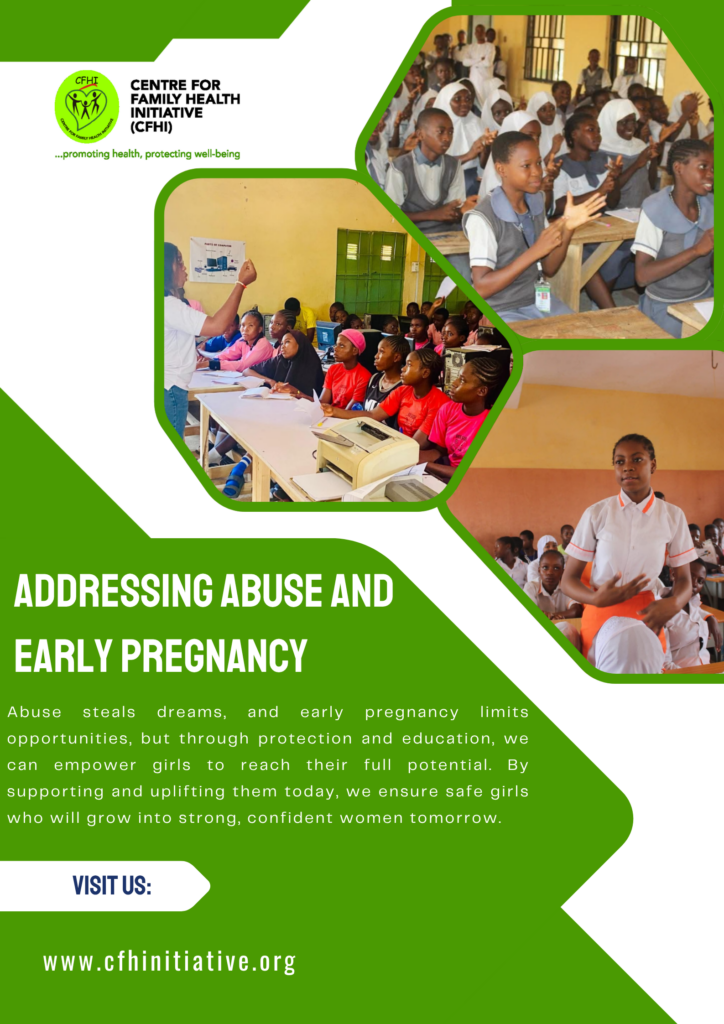
Addressing Abuse and Early Pregnancy

Abuse and early pregnancy continue to threaten the health, dignity, and future of women and girls globally. These issues are deeply rooted in inequality and human rights violations, disproportionately affecting girls in vulnerable communities. According to the United Nations Population Fund, an estimated 21 million adolescent girls (aged 15–19) become pregnant every year in low- and middle-income countries [1]. Alarmingly, recent global findings show that more than one in eight girls experience sexual violence before the age of 18, highlighting the strong link between abuse and early pregnancy [2]. These realities underscore the urgent need for protective systems that prioritize girls’ safety, education, and health.

The causes of early pregnancy are complex and interconnected. Key drivers include poverty, lack of education, gender-based violence, child marriage, and limited access to sexual and reproductive health services. Recent research shows that adolescent pregnancy is rarely a deliberate choice but often the result of coercion, lack of autonomy, and restricted access to information and services [1]. In fragile and conflict-affected settings, these risks are even higher. A 2026 report by UNFPA revealed a sharp increase in child marriage and adolescent pregnancies in crisis-affected regions, driven by insecurity, displacement, and economic hardship [3]. In Nigeria, data indicates that one in three young women are married before age 18, further increasing the likelihood of early pregnancy and lifelong disadvantage [4].

The consequences of abuse and early pregnancy are severe and long-lasting. Health risks include complications during pregnancy and childbirth, unsafe abortions, and increased vulnerability to infections. For girls under 15, the risk of maternal death is significantly higher than for older women [1]. Socially and economically, early pregnancy often leads to school dropout, reduced employment opportunities, and cycles of poverty. Studies show that girls who become pregnant early are less likely to complete their education and more likely to face long-term financial instability [1]. Additionally, survivors of abuse often experience trauma, depression, and social stigma, which further limits their opportunities and well-being.

To address these challenges, governments, and organizations such as Centre for Family Health Initiative, UNICEF and United Nations Population Fund are implementing evidence-based interventions. These include comprehensive sexuality education, access to youth-friendly health services, enforcement of laws against child marriage and gender-based violence, and community awareness programs. Recent evidence from Northern Nigeria shows that investing in girls’ education could reduce child marriage by up to two-thirds and significantly lower adolescent pregnancy rates [4]. Additionally, programs that empower girls economically, provide safe spaces, and engage men and boys in gender equality discussions have proven effective in reducing abuse and early pregnancy.

In conclusion, addressing abuse and early pregnancy requires urgent, collective action. Families, communities, governments, and organizations must work together to create safe environments where girls are protected, educated, and empowered. Every girl deserves the right to grow, learn, and make informed choices about her life without fear of violence or coercion. The call to action is clear: strengthen laws, invest in education, expand access to healthcare, and challenge harmful norms that put girls at risk. When we protect and empower women and girls, we build stronger, healthier, and more equitable societies for all.

References

[1] https://www.unfpa.org/adolescent-pregnancy/
[2]  https://data.unicef.org/topic/child-protection/violence/sexual-violence/
[3] https://www.unfpa.org/sowp
[4] https://www.unicef.org/nigeria/child-protection


Addressing Abuse and Early Pregnancy Read More »
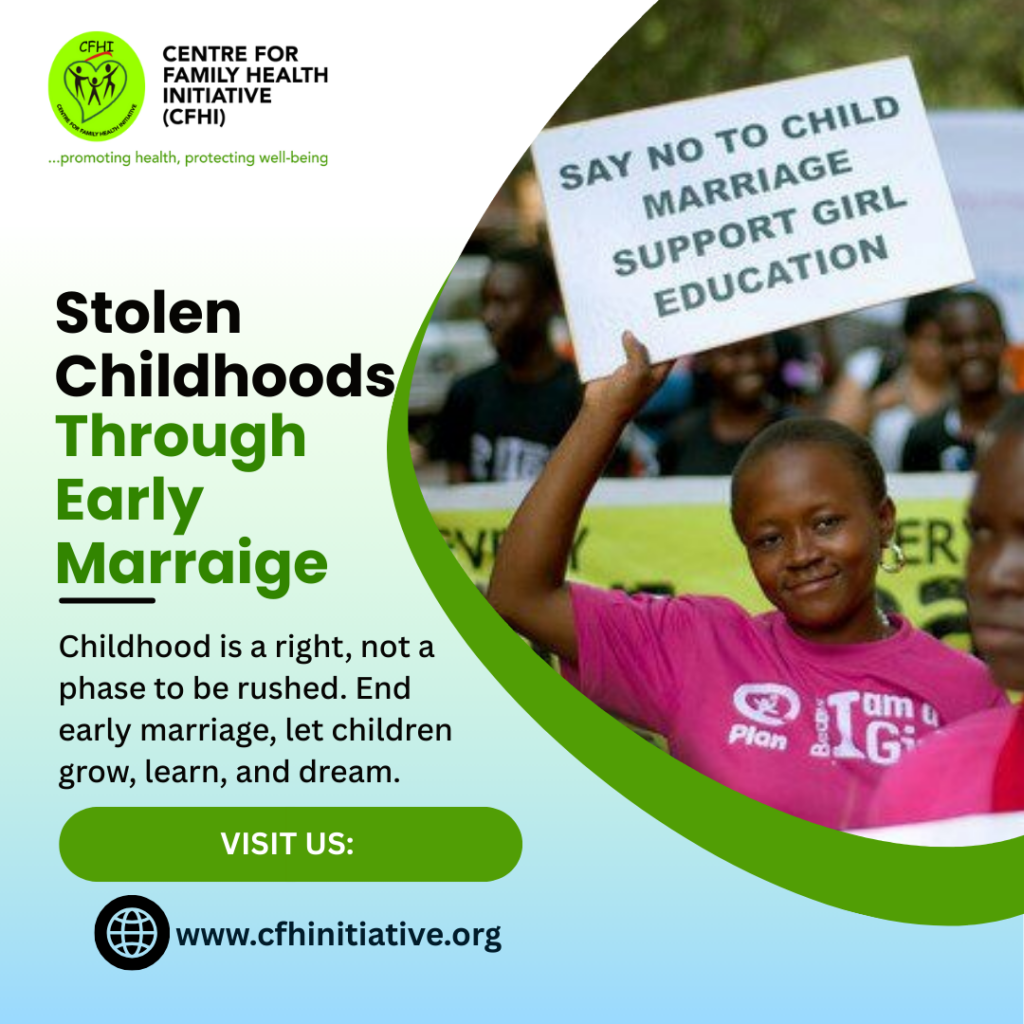
Stolen Childhoods Through Early Marriage

Child marriage, also known as early marriage, refers to any formal marriage or informal union where one or both partners are under the age of 18. Despite laws and global commitments to end this practice, it remains widespread and continues to rob millions of children especially girls of their childhoods, education, health, and future opportunities. Globally, one in five young women aged 20–24 was married before age 18, compared to one in four a decade ago, showing slow progress but not enough to meet international targets. ¹

Every year, about 12 million adolescent girls are married before the age of 18, which translates to roughly 23 girls every minute entering unwanted, early partnerships.² This practice is not evenly distributed; it is more common in low- and middle-income countries, particularly in sub-Saharan Africa, where up to 41% of girls marry before 18, and in South Asia0ttwd- .³ Nigeria, for example, has one of the highest rates of child marriage in the world: an estimated 44% of girls are married before the age of 18, although recent reports indicate this may be declining nationally to around 30% as efforts to address the issue increase.⁴

The consequences of early marriage are profound. Girls who marry as children are far more likely to drop out of school, which severely limits their future economic opportunities and perpetuates cycles of poverty and dependency. Early marriage also exposes girls to higher risks of intimate partner violence, early and risky pregnancies, maternal health complications, and poor mental health outcomes. ⁵ Research shows that child brides experience worse health and social outcomes than their unmarried peers, and these effects often extend to their own children, undermining intergenerational well-being. ⁶

The prevalence of child marriage is influenced by multiple factors including poverty, lack of education, gender inequality, social norms, and in some regions, insecurity, and conflict. Data from Nigeria’s northern regions where poverty is high and educational outcomes are low shows early marriage remains particularly entrenched, with cultural practices and limited access to schooling contributing to higher rates. ⁷ The COVID-19 pandemic and other crises have also exacerbated these risks, as school closures, economic stress, and reduced social protections have increased vulnerability to early marriage in many communities. ⁸

Efforts to reduce child marriage require a multifaceted approach. Policies and laws that set the minimum age of marriage at 18 without exceptions must be enforced; girls’ access to quality education and economic opportunities must be expanded; and communities must be engaged to shift harmful norms that condone child marriage. Programs that empower adolescent girls with information, skills, and social support have been shown to delay marriage and improve life outcomes. International commitments, such as the Sustainable Development Goal target to eliminate child marriage by 2030, emphasize the importance of sustained action, yet projections suggest that without accelerated progress, child marriage will continue for decades in many countries. ⁹

Efforts by governments, civil society, families, and communities are essential to protect children and uphold their rights. Ending early marriage is not only a matter of legal compliance, but a moral imperative to ensure that every child can grow, learn, and contribute to society as an empowered adult.

Speak Wednesday is an initiative of CFHI to address issues around gender-base violence and gender-bias.


References

  1. UNICEF. Child marriage prevalence and trends (global). https://www.unicef.org/protection/child-marriage (UNICEF USA)
  2. UNICEF Innocenti. What works to prevent child marriage. https://www.unicef.org/innocenti/innocenti/innocenti/what-works-prevent-child-marriage (unicef.org)
  3. UNICEF West and Central Africa. Child marriage in West and Central Africa. https://www.unicef.org/wca/child-marriage (unicef.org)
  4. UNICEF Nigeria. Child marriage rates and trends in Nigeria. https://www.unicef.org/nigeria/press-releases/nigeria-takes-bold-steps-end-child-marriage-and-protect-rights-children (unicef.org)
  5. Prevention Collaborative. Child, early, and forced marriage harms and impacts. https://prevention-collaborative.org/about-violence/child-early-and-forced-marriage/ (Prevention Collaborative)
  6. PubMed systematic review. Prevalence and factors associated with child marriage. https://pubmed.ncbi.nlm.nih.gov/37817117/ (PubMed)
  7. International Health (Oxford Academic). Spatial distribution of child marriage in Nigeria. https://academic.oup.com/inthealth/article/15/2/171/6589585 (OUP Academic)
  8. Early marriage and teenage pregnancy literature review (COVID-19 impacts). https://pmc.ncbi.nlm.nih.gov/articles/PMC8411836/ (PMC)
  9. UNFPA / UNICEF global programme and SDG targets. https://www.unfpa.org/child-marriage (unfpa.org)


Stolen Childhoods Through Early Marriage Read More »

SPEAK WEDNESDAY

CHILD MARRIAGE – THE MAJOR CAUSE OF THE SOCIO-ECONOMIC VULNERABILITY OF WOMEN AND GIRLS

Child marriage is a widespread violation of human rights. It is an impediment to social and economic development, and it is rooted in gender inequality. The low value placed on girls and women brings about the act and acceptability of child marriage in societies where the practice is common. According to UNICEF, Child marriage refers to any formal marriage or informal union between a child under the age of 18 and an adult or another child. Child marriage is principally practiced in the rural and poor communities where young girls are regarded as economic burden and quickly married off to assuage household expenses.

Child marriage has been a common practice among many ethnic groups in the world including Nigeria. However, it has contributed to series of negative consequences both for young girls and the society in which they live. It is a violation of human rights in general and of girl’s rights in particular. For both women and girls, child marriage has profound physical, intellectual, psychological and emotional impacts.

Aside the emotional and mental distress, intolerance, school drop-out, Fistula diseases, early widowhood, frustration and hatred for the man accompanied with child marriage,  child marriage is inherently linked to low educational level, social isolation, severe health risks which results in increased gender inequality and vulnerability to poverty for girls, young women, families and the society at a large.

It is essential that efforts be aligned towards providing easy access for girls to entrepreneurial opportunities. In 2020, CFHI through Institute of Human Virology Nigeria (IHVN) and Catholic Caritas Foundation of Nigeria (CCFN) funded projects empowered 453 women with non- interest loans to start or expand their businesses, thereby increasing their social economic capital while empowering them with financial literacy and accountability. CFHI did not only provide loans, but also provided 97 startup kits to adolescents who were trained in different skills including sewing, barbing, hair dressing, baking, furniture making, Computer, among others. Thirty-three (33) newly enrolled adolescents are still in training.

As we celebrate the International Day of Women and Girls in Science tomorrow, the promotion of girl education should be a priority for NGOs and the Government. This is an ideal solution to the issue of girl-child marriage.

Speak Wednesday is an initiative of CFHI to address issues of gender based violence and gender bias. Join us every Wednesday on all our social media platforms for more episodes.

SPEAK WEDNESDAY Read More »