#GenderTheories

CFHI Hosted Virtual Side Event During CSW70

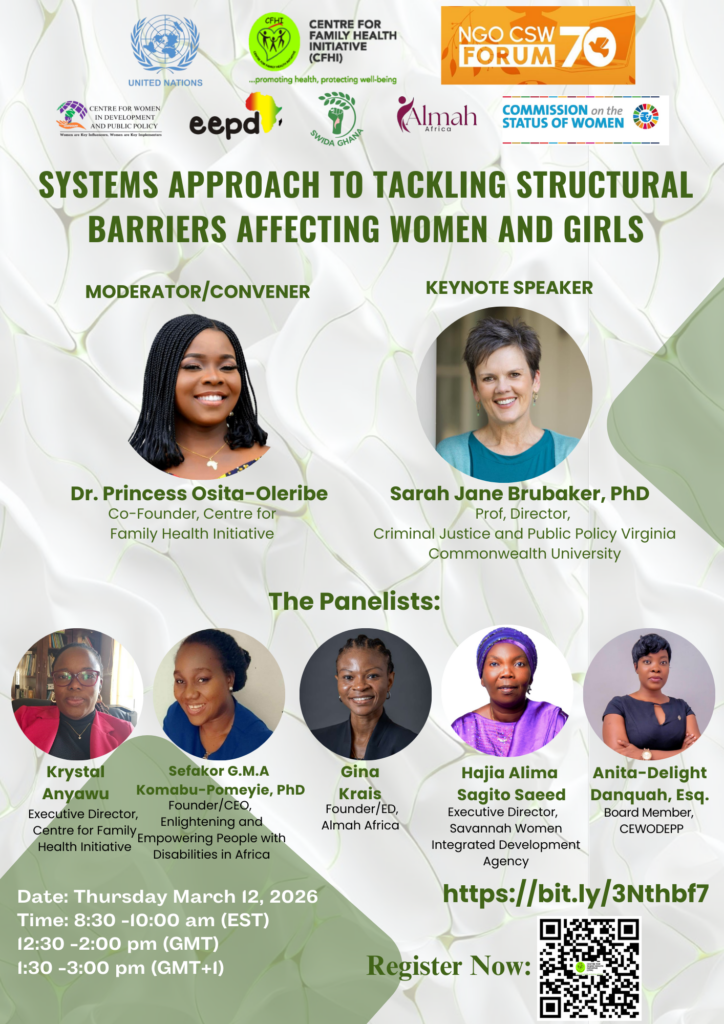
The Centre for Family Health Initiative (CFHI) successfully hosted a virtual side event on March 12, 2026, during the 70th session of the United Nations Commission on the Status of Women (CSW70). The event, titled “Systems Approach to Tackling Structural Barriers Affecting Women and Girls,” served as a critical platform for advocates, policymakers, and community leaders to confront the systemic obstacles that continue to hinder gender equality and the rights of women and girls globally.

The centrepiece of the discussion was a rigorous analysis of these structural barriers, which was scrutinized and thoroughly discussed by our esteemed keynote speaker, Sarah Jane Brubaker PhD, Director, certificate in Gender violence intervention, professor of criminal justice and public policy (Virginia Commonwealth University). Her address was particularly timely and resonant, given the recent and concerning increase in gender-based harm and structural exclusion observed among women and girls worldwide, urging attendees to move beyond passive observation toward decisive action.

To provide a comprehensive global perspective, the webinar featured a diverse panel of experts from across the world, notable speakers included Krstyal Anyanwu, Sefakor G.M.A Komabu-Pomeyie, PhD, Gina Krais, Hajia Alima Sagito Saeed, Anita-Delight Danquah Esq. who provided localized insights into the African context. Their collective expertise highlighted how interconnected legal, economic, and social systems must be reformed to effectively protect women and girls.

The reach of the event was truly expansive, drawing a wide audience of over 100 active participants from across Africa and beyond, representing various spheres of life, including civil society, academia, government, and grassroots activism. This high level of engagement underscored a shared commitment to breaking down barriers and fostered a vibrant environment where participants from different backgrounds could unite under the common goal of advancing social justice and gender empowerment.

A highlight of the session was the dedicated Q&A segment, where the audience actively participated by posing insightful questions to the panel. This interactive portion allowed for a deeper exploration of the practical pathways for change, as attendees shared their own experiences and sought strategies to navigate the unique challenges faced in their respective communities. The dialogue demonstrated the power of collective wisdom in shaping future advocacy efforts.

We are proud to have facilitated this essential conversation and remain dedicated to the ongoing pursuit of an equitable future. You can watch the full recording of this impactful session and hear the complete contributions of our speakers on our official YouTube channel here: https://youtu.be/O0b7g8bQxUs.


CFHI Hosted Virtual Side Event During CSW70 Read More »
Gender-Bias Sustains Violence Against Girls

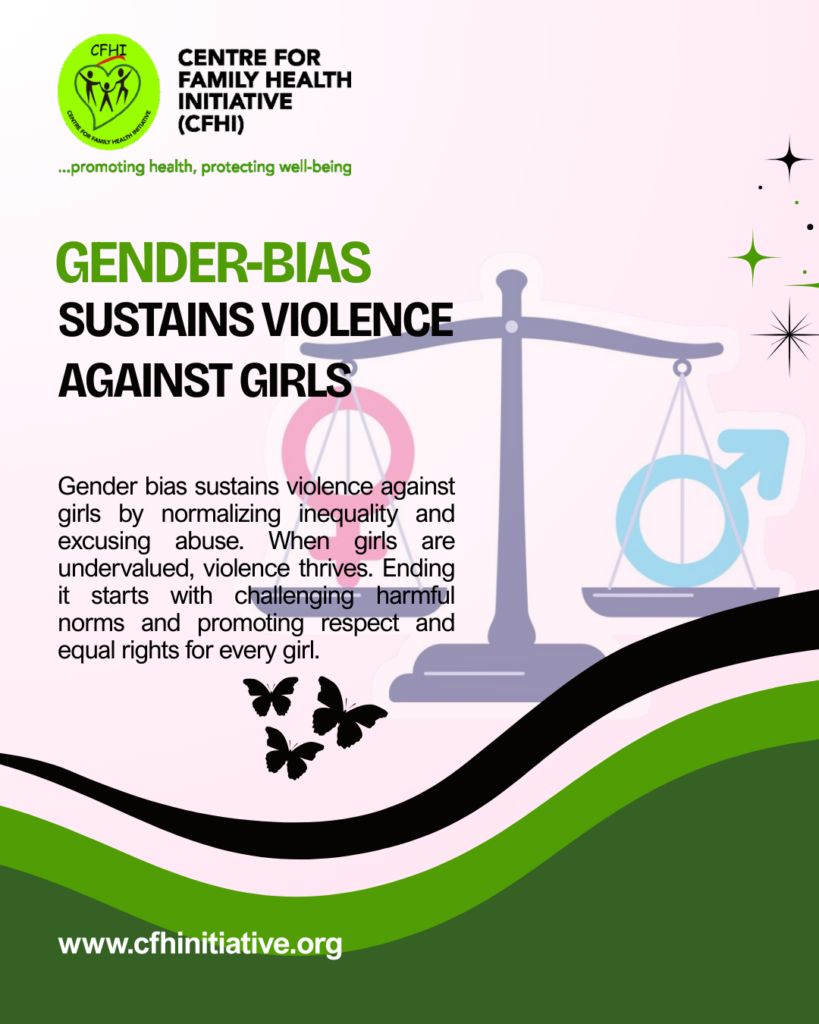
Across the globe, gender bias fuels and sustains violence against girls, shaping social norms that devalue their rights, safety, and dignity. Gender bias refers to the systemic prejudice that privileges one gender over another, embedding harmful beliefs about power, control, and worth. These biases are not abstract they manifest in everyday interactions, institutional policies, cultural practices, and legal frameworks that indirectly condone or fail to protect girls from violence and discrimination. Gender bias is a root cause of many forms of gender-based violence, contributing to a world where nearly 1 in 3 women and girls experience physical or sexual violence in their lifetime, most often from intimate partners or family members. This stark reality reflects deep-seated inequalities and underscores how societal norms around gender perpetuate violence rather than prevent it. (UN Women Knowledge hub)

Gender bias does not only drive overt acts of violence; it also grows through socialization and cultural messaging that position girls as subordinate or less valuable. In many communities, girls are more likely to face early marriage with 1 in 5 women aged 20–24 first married before age 18 a practice rooted in beliefs that girls need male guardianship and are better suited to domestic roles than education or economic participation. These harmful norms create environments where violence against girls is tolerated or overlooked, and where girls themselves may internalize messages that diminish their sense of self-worth and agency. (violenceagainstchildren.un.org)

The consequences of violence sustained by gender bias are severe and far-reaching. Beyond physical injuries, girls and young women who experience violence are at greater risk of anxiety, depression, post-traumatic stress, unintended pregnancy, and sexually transmitted infections. The psychological impact can hinder education, employment, and social participation, trapping survivors in cycles of marginalization. When legal systems, communities, and institutions fail to protect girls or address the bias that underpins violence, they perpetuate impunity and signal that girls’ safety is negotiable rather than a human right. (UN Women Knowledge hub)

Efforts to combat gender-based violence must therefore confront the gender bias that sustains it. This means challenging societal norms that excuse controlling behaviour, silence survivors, or blame victims for the harm inflicted upon them. It requires that governments strengthen legal protections, enforce laws that criminalize domestic and sexual violence, and ensure survivors have access to justice and support services. It also means investing in community education that promotes gender equality, respectful relationships, and non-violent conflict resolution. Addressing gender bias is central to dismantling the conditions that allow violence against girls to persist. (UN Women Knowledge hub)

True change demands collective action from families, teachers, health workers, policymakers, and young people themselves to build cultures that respect girls’ autonomy, voices, and contributions. Eliminating violence against girls is not simply a matter of responding to individual incidents; it is a long-term effort to transform the biases that place girls at risk in the first place. Communities that challenge harmful gender norms and promote equality create safer, healthier, and more just environments for all children and future generations.

Call to action: Governments, civil society, community leaders, educators, and individuals must work together to replace harmful gender stereotypes with norms that respect human rights and dignity. Strengthening legal frameworks, investing in prevention programmes, supporting survivors, and promoting gender-equal education are essential steps toward a future where girls can live free from violence and realize their full potential.

References

• UN Special Representative on Violence Against Children: Girls
https://violenceagainstchildren.un.org/content/girls (violenceagainstchildren.un.org

Gender-Bias Sustains Violence Against Girls Read More »

SPEAK WEDNESDAY

GENDER THEORIES PART 4 – Social Learning Theory by Judith Butler.

(Masculinity and Femininity roles are not biologically fixed but socially constructed)

Social learning theorists hold that a huge array of different influences socialize us as women and men. Females become women through a process whereby they acquire feminine traits and learn feminine behavior. Masculinity and femininity are thoughts conceived through nurture or upbringing. The roles are never innate but with how the society has actually interpreted it.
In our contemporary African society, we put conscious and deliberate efforts towards impacting good values into our female children as compared to the male children. Judith Butler’s gender theory of masculinity and femininity opines that when we equally treat every child alike, we most likely would have almost same features in both the male and female folks. This is because feminine and masculine roles as created and accepted by people in the society is a misconception.
Historically, many feminists have understood ‘woman’ differently: not as a sex term, but as a gender term that depends on social and cultural factors (like social position). In so doing, they distinguished sex (being female or male) from gender (being a woman or a man), although most ordinary language users appear to treat the two interchangeably. More recently this distinction has come under sustained attack and many view it nowadays with (at least some) suspicion.
Feminine and masculine gender-norms, however, are problematic in that gendered behavior conveniently fits with and reinforces women’s subordination so that women are socialized into subordinate social roles: they learn to be passive, ignorant, docile, emotional help meets for men. Since these roles are simply learned, we can create more equal societies by ‘unlearning’ social roles. That is, feminists should aim to diminish the influence of socialization.

SPEAK WEDNESDAY Read More »

SPEAK WEDNESDAY

SPEAK WEDNESDAY – GENDER THEORIES PART 3

(OBJECT RELATIONS THEORY)

According to Object Relations Theory, humans are birthed with an inbuilt capacity to make and sustain relationships and to socialize in their various environment. Once a baby makes his/her first entry into the world, the innate capacity begins to develop immediately he meets “the object”. The object is usually an interior image of one who constantly cares for the infant. In most cases, the first object is the child’s mother. Other objects are the father or guardian who take up parenting responsibilities.

Sάndor Ferenczi initiated the first idea of the Object Relations Theory, followed by other scholars in the 1930’s, 40’s and 50’s who extended the theory. However, in 1952, Ronald Fairbairn popularized his theory of Object Relations. These scholars who have contributed to the development of the theory are trying to explicate the role of “the object” in the development of a child psyche.

The theory proposes that family incidences as infants grow tend to structure the way people socialize with others in their environment. Experiences in adulthood may alter the individual’s personality but the impact from “the object” during childhood still greatly influences the person even as he/she grows older. Children raised in a home ravaged by Gender Based Violence tend to be aggressive as adults and see violence as normal in every home or develop low self-esteem. These positive and negative incidences shapen their character and behavior consciously or unconsciously.

Ronald Fairbairn believes that the first object (mother) plays a key role in the formation of a child’s character. Therefore, emphasizing the importance of raising children in a healthy environment. A mother takes care of her children and unconsciously her children begin to form character from the things they watch her do and say. Mothers’ Day is celebrated not just because a mother cares for her children but because the society understands that a mother plays a key role in producing either bad or patriotic citizens.

SPEAK WEDNESDAY Read More »

SPEAK WEDNESDAY- GENDER THEORIES PART 2

SPEAK WEDNESDAY- GENDER THEORIES PART 2

(STANDPOINT THEORY BY DOROTHY SMITH)

Through the standpoint theory, Smith argues that notions and beliefs are greatly influenced by location. “We begin from the world as we actually experience it, and what we know of the world and of the other is conditional on that location” (Smith 1987).

At different parts of the world, harboring different kinds of people, beliefs, religions, ideologies and values define who we are and what we believe. To her, as we grow, our values developed from incidences around our environment and this is why the value placed on each gender differs in every society. Then, we begin to take stands (stand point) in our society from what we know through our experiences and the experiences of others.

In Africa, male children are celebrated over their female folks and this has in so many ways contributed to how less important females feel at home, school, social gathering and even at work place. This has affected the mind-set of most female children and as they grow into adulthood, they are made them see themselves as the weaker gender, whose voice should be heard only when asked.

Since we were all born at different locations of the world, we lack the entire knowledge of it. No one knows the entire information of the world. Smith therefore puts a limitation on the knowledge of man.

According to Smith, standpoint is individualistic. This means that no two persons can have the same standpoint irrespective of if they were born and raised in the same environment or society. She therefore encourages us to take our standpoint seriously because it explicates the totality of an individual.

SPEAK WEDNESDAY- GENDER THEORIES PART 2 Read More »