In countless Nigerian homes, young girls often called “housegirls” begin their workdays at sunrise and end them well after sundown. What seems like an innocent gateway to opportunity can quickly morph into a nightmare. What started as helping with domestic duties becomes abuse, neglect, and exploitation. This is not just work. It is a system that too often silences their voices and sabotages their futures.
The Hidden Reality
Recent research shows that in Nigeria, about 50 percent of child domestic workers experience some form of violence. Emotional abuse affects nearly half, while nine percent face physical violence, and others suffer sexual violence in silence. These girls often live in cramped, unfamiliar spaces with no personal freedom or support network. At school, they are either absent due to long work hours, the majority work over 30 hours weekly, or pulled out entirely, with 19 percent reporting disruption in education.
At its worst, this becomes modern slavery where girls are trapped by fear, threats, and the absence of choices. In parts of Southern Nigeria, studies show that underage domestic helpers regularly face psychological, emotional, and physical abuse without any form of redress.
This is not just unethical. It is a crime. Every Nigerian girl has the right to safety, freedom, and education; rights protected under Nigeria’s Violence Against Persons Prohibition (VAPP) Act of 2015. But beyond the law, we are talking about broken childhoods, girls robbed of their innocence, and women who grow up never knowing their worth.
Real Voices Real Harm
Imagine a 14-year-old working from dawn to dusk. She is beaten for small mistakes, denied food until everyone else has eaten, isolated from her peers, and barred from attending school. She wakes up to work, sleeps in fear, and grows into womanhood carrying the weight of a stolen girlhood. This is not fiction. This is her everyday reality.
What We Can Do
- Recognize and Report
If you suspect abuse, contact the National Agency for the Prohibition of Trafficking in Persons NAPTIP, Child Protection Network, CFHI, or your local police station. These girls need protection, not more silence.
- Educate Families
Many parents send their daughters to work in cities with the hope of better opportunities. But without information, legal backing, and proper monitoring, what should uplift them becomes a risk. Raising community awareness is vital.
- Support NGOs Doing the Work
The Centre for Family Health Initiative (CFHI) has remained at the frontline of protecting women and girls. CFHI supports victims of gender-based violence through legal aid, psychosocial support, community education, and survivor-led advocacy. From community outreaches to engaging in policy work, CFHI ensures these girls are seen, heard, and helped.
Now Is the Time to Act!
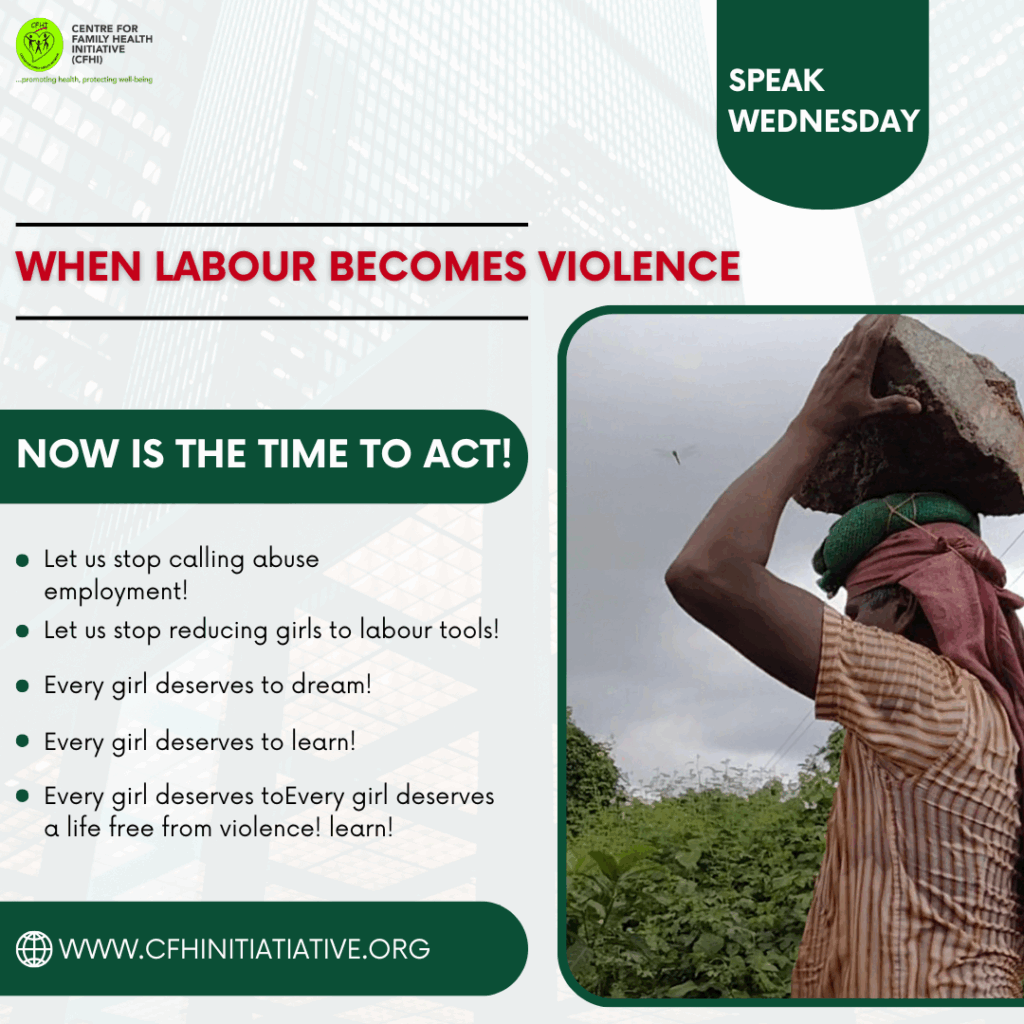
We have seen the data. We have heard the stories. Now we must act. Let us stop calling abuse employment. Let us stop reducing girls to labour tools. Every girl deserves to dream. Every girl deserves to learn. Every girl deserves a life free from violence.
Speak Wednesday is an initiative of CFHI to address issues around gender-based violence and gender bias.
#SpeakWednesday #ProtectHousegirls #EndChildDomesticViolence #GirlsAreNotServants #CFHI #EndGBV #HumanRightsMatter