Closing the Gender Wealth Gap to End Violence Against Women
Economic justice is the key to safety, health, and empowerment for women worldwide. Every Wednesday, we raise our voices to challenge injustice, and today we confront one of the most entrenched roots of gender-based violence: economic inequality. The gender wealth gap isn’t just a financial statistic; it’s a silent enabler of abuse, a barrier to freedom, and a public health emergency.
Globally, women earn less than men for the same work3, own less property, have limited access to leadership4 and fewer financial safety nets1. This economic disparity creates a cycle of dependency that heightens exposure to violence and limits the ability to escape abusive environments. In Nigeria, for instance, the Minister of Women Affairs recently emphasized that closing the gender gap could add ₦15 trillion to the country’s GDP annually by 20252, underscoring the economic potential of gender equity.
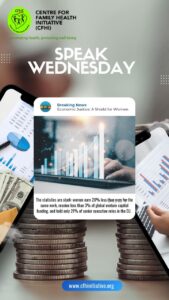
These issues are persistent and global. In the EU, despite the “Women on Boards” directive aiming for 40% female representation by 2026, progress is slow. Women currently hold only 35% of non-executive roles and 21% of senior executive positions 4. This is despite evidence from a 2025 report showing that companies with greater gender diversity are 25% more likely to be more profitable3. In sectors like tech and finance, women continue to report being passed over for promotions, excluded from decision-making, and subjected to gender-based microaggressions, which stifles their economic advancement4.
Call To Action
To end violence against women, we must invest in their economic power. As outlined in a UN Women 2025 advocacy paper, closing the funding gap in programs that support survivors and prevent violence is critical1. We call on Governments, NGOs, and private sector to collaborate on expanding access to education and vocational training, supporting women-led businesses and financial literacy programs, funding essential services for survivors, including shelters, legal aid, and healthcare, and advocating for and enforcing equal pay and robust workplace protections.
At the Centre for Family Health Initiative (CFHI), we are committed to this work. Through collaborations with partners like the Institute of Human Virology Nigeria (IHVN), Caritas Nigeria, FCT Social Development Secretariat (SDS), TY Danjuma Foundation (TYDF), and Global Philanthropy Alliance (GPA), we have empowered over 2500 women and girls with education, vocational training, business start-up kits, and financial support.
Financial inequality isn’t just unfair; it’s dangerous. It limits women’s choices, increases health risks, and perpetuates cycles of violence and poverty. Empowering women economically is not merely a matter of justice; it is the essential foundation for building safer, healthier societies for all.
Speak Wednesday is an initiative of CFHI to address issues around gender-based violence and gender bias.
References
- UN Women. Closing the funding gap to end violence against women and girls [Internet]. 2025 [cited 2025 Oct 21]. Available from: https://knowledge.unwomen.org/sites/default/files/2025-06/closing-the-funding-gap-to-end-violence-against-women-and-girls-en.pdf
- The Guardian Nigeria. Closing gender gap will add ₦15tr to Nigeria’s GDP by 2025 [Internet]. 2025 [cited 2025 Oct 21]. Available from: https://guardian.ng/news/closing-gender-gap-will-add-n15tr-to-nigerias-gdp-by-2025/
- Women in the workplace 2025: Research and trends [Internet]. 2025 [cited 2025 Oct 21]. Available from: https://www.wellable.co/blog/women-in-the-workplace-2025-research-and-trends
- IMD. Gender inequality in the workplace: Why it persists? [Internet]. 2025 [cited 2025 Oct 21]. Available from: https://www.imd.org/research-knowledge/articles/gender-inequality-in-the-workplace-why-it-persists/