Health Communication

SPEAK WEDNESDAY

DISRUPTING PATRIARCHY

According to Wikipedia, Patriarchy is a social system in which men hold primary power and predominate in roles of political leadership, moral authority, social privilege and control of property. Some patriarchal societies are also patrilineal, meaning that property and title are inherited by the males only.

Patriarchy influences different areas of the society including culture, family, school, the workplace and relationships. Its presence can translate to inequality and gender-based violence. The idea of patriarchy is not peculiar to a specific group of people, but one that extends and supersedes all borders, socioeconomic class, race, and more.

In Nigeria, it is observed by different researchers including European Scientific Institute that . Hence, there is the commonality of general belief system that the best place for women is in the ‘Kitchen’. This trend has brought about tremendous misrepresentation of women right at the level of the family down to the circular society. Women are therefore discriminated upon from, in most cases, acquiring formal education, accessing proper health care, receiving equal pay, among others.

In so many parts of the world, women are forbidden to own landed properties or inherit any. In cases where the diseased did not have male children, his properties are distributed amongst his male relatives, excluding his widow and daughters who are left to fend for themselves. In these societies, women who are financially stable have to buy properties in the name of their fathers or other male relatives. All these expose women to violence before they are born until they are aged.

Zig Ziglar once said, the first step to finding a solution is to recognize there is a problem. Because of how ingrained patriarchy is in the society, it may be difficult to identify. However, if patriarchy can be learnt, it can be unlearnt. Together we can achieve a society with equal opportunities for all human irrespective of the gender differences.

Speak Wednesday is an initiative of Centre for Family Health Initiative to stop the cycle of domestic violence by breaking the silence around gender based violence and gender bias. Join us every Wednesday on all our social media handles for more episodes.

SPEAK WEDNESDAY Read More »

SPEAK WEDNESDAY

THE ROLE OF WOMEN IN HEALTH COMMUNICATION

Health communication encompasses the study and use of communication strategies to inform and influence individual and community decisions for health promotion. Health communication can help raise awareness of health risks and solutions by providing the skills and motivation needed to influence social and behavioral change, and increase demand for appropriate health services.

According to World Health Organisation (WHO), women make up 75% of the healthcare workforce in many countries affirming women’s indispensable contributions in health communication. Effective communication with health care providers on health matters is crucial in the delivery of high quality health care. Findings from National Library of Medicine (NIM) have proven that female health care providers are likely to use more patient-centred communication strategies by asking more questions, engaging in more information sharing, encouraging patient participation during interactions, and providing more psychosocial counselling to patients compared to the men.

The practices of health communication have contributed to health promotion and disease prevention in several areas. In early 2003 for example, WHO epidemiologists learned that a deadly disease known as severe acute respiratory syndrome (SARS) was quickly spreading to other countries from China. WHO and other public health officials were able to place announcement in local media such as the radio and newspaper. The radio was able to quickly disseminate the information as it is easily accessed and reaches people at the grassroots level. Also, in the case of the present Pandemic, through health communication, different countries became more prepared for Corona Virus and plans were put in place to mitigate the spread.

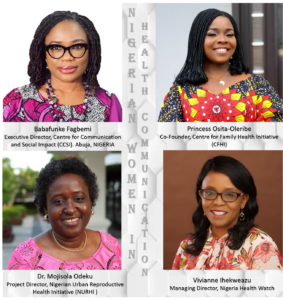
Moji Makanjuola is a female health journalist in Nigerian who has contributed significantly to the improvement and development of health journalism. She is a Media Consultant to the United Nations Women, after working for decades in the Nigerian Television Authority (NTA) where she rose to the position of head of health and gender desk. She was a pioneer member of the Centre for Diseases Control (CDC), Atlanta in USA. Presently, she is the Executive Director of International Society of Media in Public Health, and the Chief Executive Officer of Bronz and Onyx. Other examples of Nigerian women who are key players in health communication include; Princess Osita-Oleribe, the Co-Founder, Centre for Family Health Initiative (CFHI); Babafunke Fagbemi, Executive Director, Centre for Communication and Social Impact (CCSI); Dr. Mojisola Odeku, Project Director, Nigerian Urban Reproductive Health Initiative (NURHI); Vivianne Ihekweazu, Managing Director, Nigeria Health Watch, among others.

Female participation in health communication does not only enable timely information access to the family members, it also strengthens gender transformative change to improve women health and access to health care and services. For effective health communication strategies, more women should be involved in the process of disease control right from the planning stage through to implementation and evaluation.

Speak Wednesday is an initiative of Centre for Family Health Initiative to stop the cycle of domestic violence by breaking the silence around gender based violence and gender bias. Join us every Wednesday on all our social media handles for more episodes.

SPEAK WEDNESDAY Read More »