Monday Health Burst

MONDAY HEALTH BURST

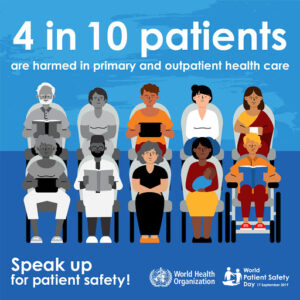
PATIENT SAFETY

The simplest definition of patient safety according to World Health Organization, is the prevention of errors and adverse effects to patients associated with health care.

Unhealthy conditions of the body or mind displace people from the normal state of health thereby deterring their physical or mental wellbeing. It is expected for such individuals to seek out solutions to their health challenges through different means available and accessible to them. Nowadays, people utilize the health services of trained medical practitioners to recuperate and expect that they will be cared for in a safe manner. Unfortunately, there are so many recorded cases of medical negligence resulting in injury or death of patients.

Thomas Agan, the Chief Medical Director (CMD), University of Calabar Teaching Hospital (UCTH), once said during an interaction with journalists in 2017 that over 90 per cent of deaths recorded in Nigerian hospitals are due to poor attitude of health workers. He also mentioned that until healthcare providers are held accountable for every challenge they create, things will not go down well.

Trained medical professionals legally owe a duty of care to their patients. Universally, Medical practitioners are governed by the Hippocratic Oath pledged at serving humanity with optimum capacity. One of the several laws governing medical practice in Nigeria is Medical and Dental Practitioner Act (CAP M8), structured to regulate medical ethics and rules of professional conduct. Infringement of this duty through medical malpractices such as wrong diagnosis and treatment, polypharmacy, defective medical products, and other illegal practices resulting to some form of damage to the patient qualifies as medical negligence. It is pertinent to understand that medical negligence is not exclusive to medical doctors but includes nurses, technicians, pharmacists and other health care providers.

It is no news that a lot of progress needs to be made as a nation in providing an enabling environment with modern and innovative equipment to aid medical practitioners in carrying out their duties. Doctors in government hospitals constantly have to demand adequate remuneration, but some health care providers now use this as facades masking so many cases of medical negligence.

Maintaining patient safety and care requires cooperative effort from all health care providers responsible for patient care. Team work not only provides the safest care but improves medical management especially in diagnosis and treatment of patients. It may not be totally possible to eradicate crisis emanating from medical negligence but, with quality health care work force, the right hospital leadership and management, and the right health care facility and infrastructure, it can be controlled.

Developing active networks of patients and providers, sharing experiences, learning from failure and pro-active risk assessment, facilitating effective evidence-based care, monitoring improvement, empowering and educating patients and the public as partners in the process of care are some of the key factors to consider in achieving a quality agenda.

Monday Health Burst is an initiative of Centre for Family Health Initiative (CFHI) to tackle issues of basic health concerns. Join us every Monday for more health-related articles on all our social media platforms.

MONDAY HEALTH BURST Read More »
MONDAY HEALTH BURST

SUICIDE PREVENTION

Suicide is the act of intentionally causing one’s own death. According to World Health Organization (WHO), close to 800,000 people die by suicide every year and for each suicide, there are more than 20 suicide attempts. The WHO report also states that suicide is the third leading cause of death between the age of 15-19 globally. However, about 79% of suicides occur in low- and middle-income countries.

Nigeria is ranked “15th in the world” and “top in Africa” for its suicide rate, according to Global Health Equity (GHE). Due to the stigma associated with suicide in Nigeria, most cases are not reported. However, some of the widely reported suicide cases include that of a 100-level student of Kogi State University, Ayingba, who ended her life because her boyfriend left her, a student of Chemical Engineering at the University of Port Harcourt, Rivers State, who committed suicide by drinking two bottles of the deadly pesticide, the University of Ibadan lecturer, who took his life on April 6, 2019, after an unfulfilled dream of completing his PhD programme, a worker in Kogi State over alleged nonpayment of salary, among others.

The link of suicide and mental disorder (depression and alcohol abuse) is well established especially in high income countries but many suicides happen impulsively in moments of crisis with a breakdown in the ability to deal with life stresses, such as financial problems, relationship break-up or chronic pain and illness. Experiencing conflict, disaster, violence, abuse, or loss and a sense of isolation are strongly associated with suicidal behaviour. Suicide rates are also high amongst vulnerable groups who experience discrimination, such as refugees and migrants, lesbians, gays, bisexuals, transgenders, intersex (LGBTI) persons, and prisoners. The strongest risk factor for suicide according to WHO report is a previous suicide attempt.

It is estimated by WHO that around 20% of global suicides are due to pesticide self-poisoning, most of which occur in rural agricultural areas in low- and middle-income countries. Other common methods of suicide are hanging and firearms. Knowledge of the most used suicide methods is important to devise prevention strategies which have shown to be effective, such as restriction of access to means of suicide.

Suicides are preventable with timely, evidence-based, and often low-cost interventions. There are several measures that can be taken at population, sub-population, and individual levels to prevent suicide and suicide attempts. These include: Reducing access to the means of suicide (e.g. pesticides, firearms, certain medications), introducing alcohol policies to reduce the harmful use of alcohol, early identification, treatment and care of people with mental and substance use disorders, chronic pain and acute emotional distress, training of non-specialized health workers in the assessment and management of suicidal behaviour, follow-up care for people who attempted suicide and provision of community support, improving coping strategies of people who are at risk, reducing risk factors for suicide, such as poverty, and giving hope for a better life after current problems are resolved.

In conclusion, Suicide is a complex issue and therefore suicide prevention efforts require coordination and collaboration among multiple sectors of society, including the health sector and other sectors such as education, labour, agriculture, business, justice, law, defence, politics, and the media.

Monday Health Burst is an initiative of Centre for Family Health Initiative (CFHI) to tackle issues of basic health concerns. Join us every Monday for more health-related articles on all our social media platforms.

MONDAY HEALTH BURST Read More »