Suicide Prevention

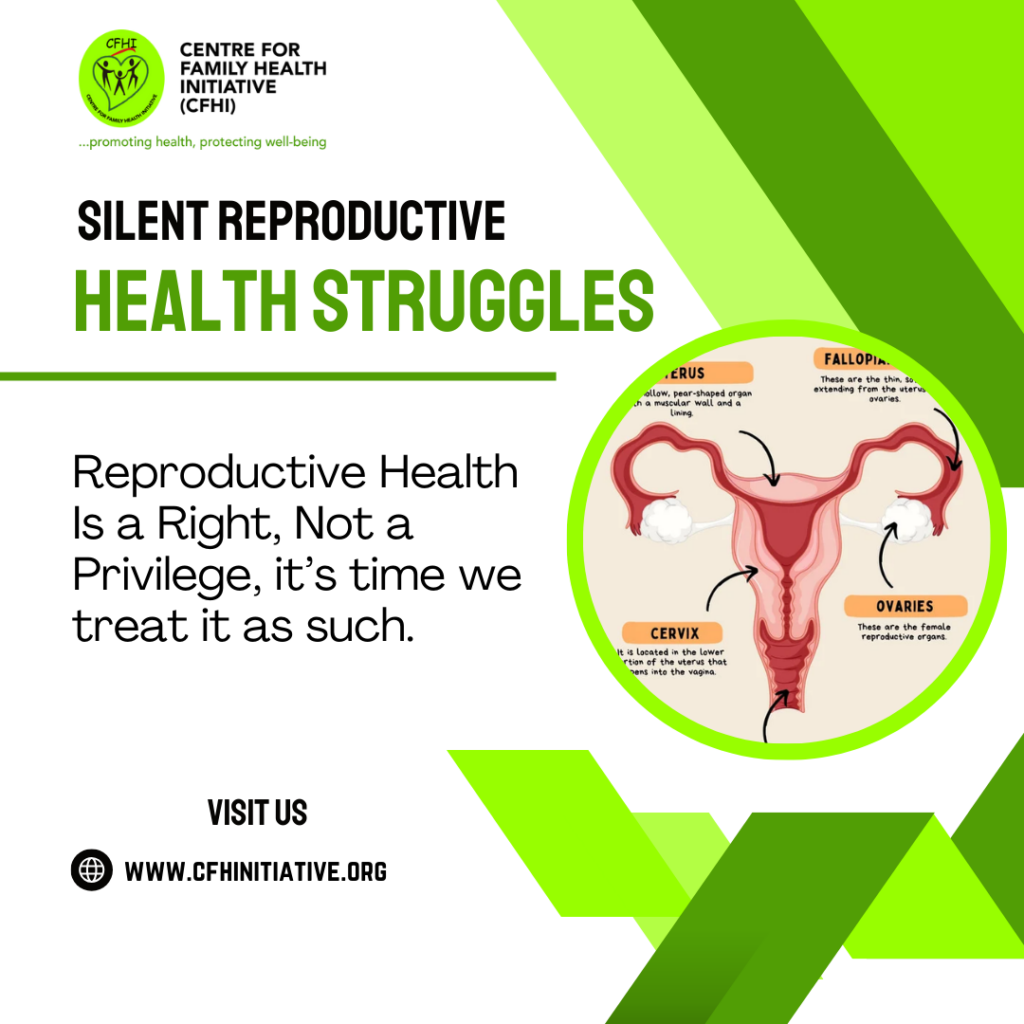
Silent Reproductive Health Struggles

Women’s reproductive health is fundamental to their overall well-being, yet millions of women globally and in Nigeria face persistent, often silent challenges that compromise their health, autonomy, and quality of life [1]. Despite progress in some areas, vast inequities remain in access to services, information, and rights leaving many women vulnerable to preventable health problems [2].

One of the major silent struggles is limited access to essential reproductive health services, including family planning, maternal care, and safe delivery support. In sub-Saharan Africa, one in four women who wish to delay or stop childbearing do not use any contraceptive method, reflecting gaps in availability, choice, and quality of reproductive care [1][5]. These shortfalls contribute to high rates of unintended pregnancies, unsafe abortions, and increased maternal morbidity and mortality. Globally, about 800 women die each day from pregnancy-related causes, many of which are preventable with proper services and support [1].

In Nigeria, reproductive health disparities are stark. A survey of reproductive health concerns found that sexual health, contraception, infections, fertility issues, and reproductive cancers were among the most pressing worries for women, indicating broad unmet needs across the reproductive spectrum [3]. Despite various policies, only a few Nigerian states meet benchmarks for women’s participation in decisions about their sexual and reproductive health, reflecting systemic barriers rooted in socio-cultural norms and limited autonomy [4]. Economic challenges also contribute, with millions of women lacking access to modern contraceptives and comprehensive family planning services due to cost, misinformation, fear of side effects, cultural opposition, and weak health systems [5][6].

Another under-recognized struggle is infertility, which affects a significant portion of women yet remains stigmatized and poorly supported. Recent WHO guidance highlights infertility as a major public health concern, with more than one in six people of reproductive age affected [7]. Access to affordable fertility evaluation and treatment is limited in many countries, forcing women to choose between financial hardship and their desire for children [7].

Maternal health remains a critical issue. Globally, approximately 287,000 women die yearly from complications in pregnancy and childbirth, with nearly all these deaths occurring in low- and middle-income settings where health systems are weak and resources scarce [1]. In areas affected by conflict or economic strain, such as parts of northern Nigeria, women face even greater risks due to disrupted services, insecurity, and collapsed care infrastructure [8].

The impact of these struggles extends beyond physical health. When women cannot access respectful, quality reproductive care, the consequences ripple into social and economic domains limiting educational opportunities, reducing workforce participation, and perpetuating cycles of poverty and inequality [2].

Improving women’s reproductive health requires a holistic approach that ensures affordable and accessible services such as contraception, antenatal care, skilled delivery, and emergency support reach even the most underserved communities [1][5], while also equipping women with accurate, culturally sensitive information to make informed choices about their bodies and health [2]. At the same time, policies must actively protect women’s autonomy and reproductive rights by challenging harmful norms and discrimination [2][4], supported by strong, well-funded health systems with trained personnel to guarantee continuity of care, especially in fragile settings [1][8]. Integrating affordable infertility care and psychosocial support into routine reproductive health services is also essential to address the often hidden emotional and social burdens many women silently endure [7].

Speak Wednesday is an initiative of CFHI to address issues around gender-base violence and gender-bias.

References

  1. WHO Regional Office for Africa. Women’s Health. Available from: https://www.afro.who.int/health-topics/womens-health
  2. United Nations Population Fund (UNFPA). New UNFPA report finds 30 years of progress in sexual and reproductive health has mostly ignored the most marginalized communities. Available from: https://www.unfpa.org/press/new-unfpa-report-finds-30-years-progress-sexual-and-reproductive-health-has-mostly-ignored
  3. Sa’adatu TS, Dieng B, Danmadami AM. Reproductive health issues of concern among Nigerians: an online survey. Int J Community Med Public Health. Available from: https://doi.org/10.18203/2394-6040.ijcmph20234114
  4. Premium Times Nigeria. Only eight Nigerian states meet women’s health benchmark – Report. Available from: https://www.premiumtimesng.com/news/top-news/830200-only-eight-nigerian-states-meet-womens-health-benchmark-report.html
  5. World Health Organization. Sexual and Reproductive Health and Research (SRH): Family planning and contraception. Available from: https://www.who.int/teams/sexual-and-reproductive-health-and-research-%28srh%29
  6. Ballard Brief. Barriers to Family Planning for Women in West Africa. Available from: https://ballardbrief.byu.edu/issue-briefs/barriers-to-family-planning-for-women-in-west-africa
  7. WHO releases first global guideline on infertility care. Reddit; 2025. Available from: https://www.reddit.com/r/EmbryologyIVFSupport/comments/1pcjrzh/who_releases_first_global_guideline_on/
  8. AP News. Pregnancy has become a nightmare for many women in Nigeria’s conflict-hit north. Available from: https://apnews.com/article/c5846961ed87cddd8a24d1c2b04564a0

Silent Reproductive Health Struggles Read More »

SPEAK WEDNESDAY

WOMEN DEALING WITH SUICIDE

Wikipedia defines suicide as the act of intentionally causing one’s own death. Suicide is a public health problem, and it is seen as a public health priority by the World Health Organization (WHO). According to WHO, Suicide is the result of an act deliberately initiated and performed by a person in the full knowledge or expectation of its fatal outcome. Close to 800,000 people die due to suicide every year and it is considered the third leading cause of death in 15-19-year old.

Studies show that women make more suicide attempts than men, but men are more likely to die in the attempts than women. In Nigeria, most people do not believe depression is an illness, neither do they know the extent to which it affects the mind. Yet, between January and June 2019 alone, there were 42 reported cases of suicide that occurred in different parts of the country. An example is the story of Hikmat Gbadamosi, a 100-level student of the University of Port Harcourt, Rivers State. She was alleged to have consumed two bottles of insecticide (Sniper) after showing signs of depression and had opted to live away from her colleagues in the school.

According to Centre for suicide prevention, identified risk factor for suicide attempts and other suicidal behaviours in women include postpartum depression (PPD) affects around 15% of women and is experienced after giving birth and for up to one year after, prenatal period (The time during pregnancy and the first year after the birth of a child)- most women who die during this period have an affective or anxiety-related disorder, domestic violence (women experience partner violence nine times more than men according to different research) which in turn leads to post traumatic stress disorder (PTSD), and childhood sexual abuse. Other risk factors may include family history of suicide, family conflict, broken homes, anti-social behaviour, and poor peer relationships.

Suicide prevention begins with recognizing the warning signs and taking steps to make sure it does not happen. Though most people contemplating suicide often believe they are helpless, it is necessary to ask for external assistance, mostly a physician who can help find the medication or therapy that is suitable for the person. It is also important to take away harmful tools from their reach and make sure they are never left alone.

Speak Wednesday is an initiative of Centre for Family Health Initiative to stop the cycle of domestic violence by breaking the silence around gender-based violence and gender bias. Join us every Wednesday on all our social media handles for more episodes.

SPEAK WEDNESDAY Read More »

MONDAY HEALTH BURST

SUICIDE PREVENTION

Suicide is the act of intentionally causing one’s own death. According to World Health Organization (WHO), close to 800,000 people die by suicide every year and for each suicide, there are more than 20 suicide attempts. The WHO report also states that suicide is the third leading cause of death between the age of 15-19 globally. However, about 79% of suicides occur in low- and middle-income countries.

Nigeria is ranked “15th in the world” and “top in Africa” for its suicide rate, according to Global Health Equity (GHE). Due to the stigma associated with suicide in Nigeria, most cases are not reported. However, some of the widely reported suicide cases include that of a 100-level student of Kogi State University, Ayingba, who ended her life because her boyfriend left her, a student of Chemical Engineering at the University of Port Harcourt, Rivers State, who committed suicide by drinking two bottles of the deadly pesticide, the University of Ibadan lecturer, who took his life on April 6, 2019, after an unfulfilled dream of completing his PhD programme, a worker in Kogi State over alleged nonpayment of salary, among others.

The link of suicide and mental disorder (depression and alcohol abuse) is well established especially in high income countries but many suicides happen impulsively in moments of crisis with a breakdown in the ability to deal with life stresses, such as financial problems, relationship break-up or chronic pain and illness. Experiencing conflict, disaster, violence, abuse, or loss and a sense of isolation are strongly associated with suicidal behaviour. Suicide rates are also high amongst vulnerable groups who experience discrimination, such as refugees and migrants, lesbians, gays, bisexuals, transgenders, intersex (LGBTI) persons, and prisoners. The strongest risk factor for suicide according to WHO report is a previous suicide attempt.

It is estimated by WHO that around 20% of global suicides are due to pesticide self-poisoning, most of which occur in rural agricultural areas in low- and middle-income countries. Other common methods of suicide are hanging and firearms. Knowledge of the most used suicide methods is important to devise prevention strategies which have shown to be effective, such as restriction of access to means of suicide.

Suicides are preventable with timely, evidence-based, and often low-cost interventions. There are several measures that can be taken at population, sub-population, and individual levels to prevent suicide and suicide attempts. These include: Reducing access to the means of suicide (e.g. pesticides, firearms, certain medications), introducing alcohol policies to reduce the harmful use of alcohol, early identification, treatment and care of people with mental and substance use disorders, chronic pain and acute emotional distress, training of non-specialized health workers in the assessment and management of suicidal behaviour, follow-up care for people who attempted suicide and provision of community support, improving coping strategies of people who are at risk, reducing risk factors for suicide, such as poverty, and giving hope for a better life after current problems are resolved.

In conclusion, Suicide is a complex issue and therefore suicide prevention efforts require coordination and collaboration among multiple sectors of society, including the health sector and other sectors such as education, labour, agriculture, business, justice, law, defence, politics, and the media.

Monday Health Burst is an initiative of Centre for Family Health Initiative (CFHI) to tackle issues of basic health concerns. Join us every Monday for more health-related articles on all our social media platforms.

MONDAY HEALTH BURST Read More »