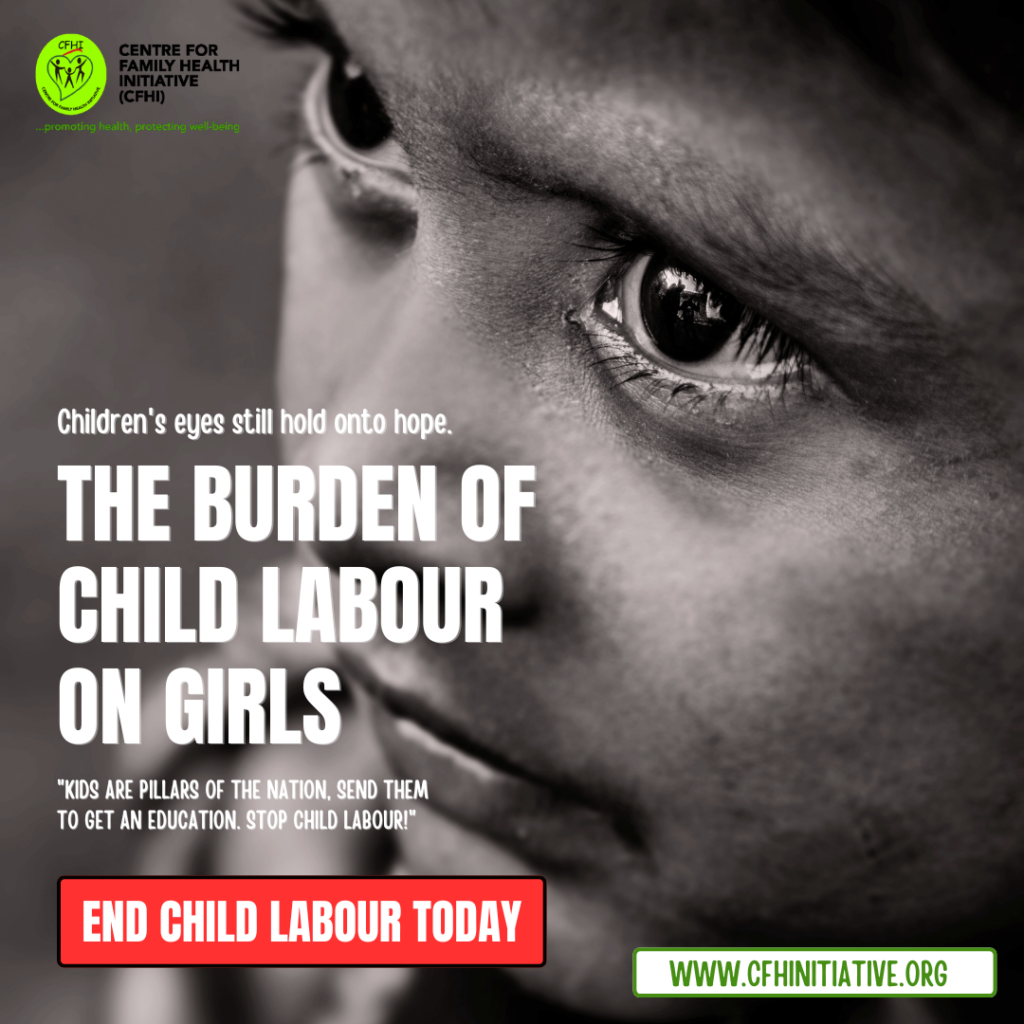
A girl carrying a tray of goods under the scorching sun while her peers sit in classrooms is a familiar sight across many communities. For some, it has become so common that it barely raises concern. Yet behind this seemingly ordinary scene lies a profound injustice that robs millions of girls of their childhood, education, health, dignity, and future opportunities.
Child labour remains one of the most persistent violations of children’s rights globally. Although progress has been made over the years, recent estimates indicate that approximately 138 million children worldwide are still engaged in child labour, with about 54 million involved in hazardous work that threatens their health, safety, and development [1]. While statistics often suggest that boys are more likely to be involved in economic labour, the true burden on girls is frequently hidden because much of their work occurs within homes and communities, where it is less visible and less likely to be counted [2].
The experience of child labour is often shaped by gender. Girls are disproportionately represented in domestic work, caregiving responsibilities, street trading, and other informal activities. In many households, girls are expected to cook, clean, fetch water, care for younger siblings, and support family businesses before and after school. When these unpaid responsibilities consume significant hours of their day, education becomes secondary and personal development suffers [2].
One of the most devastating consequences of child labour on girls is the interruption of education. A girl who spends her mornings hawking goods, caring for siblings, or working as a domestic helper is less likely to attend school regularly, complete assignments, or progress academically. Over time, absenteeism often leads to poor performance, school dropout, and limited future opportunities. This creates a cycle where poverty fuels child labour, and child labour in turn perpetuates poverty.
Beyond educational setbacks, child labour places enormous physical demands on girls. Many are exposed to long working hours, hazardous environments, heavy loads, harsh weather conditions, and dangerous substances. Girls engaged in domestic labour often work behind closed doors where exploitation can remain hidden from public scrutiny [3]. Their vulnerability is heightened by unequal power dynamics, making them susceptible to abuse, neglect, and violence.
The mental and emotional consequences are equally concerning. Childhood is a critical period for emotional growth, social interaction, and identity formation. When girls are forced into labour, they are deprived of opportunities to learn, play, build friendships, and develop confidence. Constant pressure to contribute economically or shoulder adult responsibilities can lead to anxiety, emotional distress, low self-esteem, and feelings of hopelessness. The burden becomes even heavier when girls are expected to balance labour with household duties and schooling.
Many child labourers also experience social isolation. Domestic workers often spend most of their time indoors, disconnected from peers and support systems. Such isolation increases the risk of psychological distress and limits access to protection mechanisms that could identify and address abuse [3].
The issue extends beyond individual girls and affects society. Every girl denied education and protection represents lost human potential. Communities lose future teachers, health workers, entrepreneurs, scientists, and leaders. Economies lose productive contributors. Nations lose opportunities for inclusive development. Child labour therefore is not merely a family issue; it is a social, economic, and public health challenge.
The persistence of child labour among girls is often rooted in poverty, gender inequality, limited access to quality education, weak social protection systems, and harmful social norms. In some communities, investment in boys’ education is prioritized while girls are expected to contribute to household labour. Such beliefs continue to reinforce cycles of disadvantage and inequality.
Addressing this challenge requires collective action. Governments must strengthen the enforcement of child protection laws and ensure access to free, quality education. Communities must challenge harmful gender norms that place excessive responsibilities on girls. Families need economic support and social protection programmes that reduce reliance on children’s labour. Schools must create safe and inclusive learning environments that encourage girls to remain in education. Civil society organisations, development partners, and community leaders must continue advocating for children’s rights and gender equality.
As we speak about the burden of child labour on girls, we must remember that every child deserves a childhood. Girls should be carrying books, not burdens. They should be building dreams, not sacrificing them for survival. Protecting girls from child labour is not charity; it is an investment in healthier families, stronger communities, and a more equitable society.
The question before us is not whether child labour harms girls. The evidence is overwhelming. The real question is whether society is willing to act decisively to end it.
Speak Wednesday is an initiative of CFHI to address issues of gender-based violence and gender bias.
References
[1] International Labour Organization (ILO) & UNICEF. Child Labour: Global Estimates 2024, Trends and the Road Forward. Available at: https://www.ilo.org/publications/major-publications/child-labour-global-estimates-2024-trends-and-road-forward
[2] UNICEF. What is Child Labour? Available at: https://www.unicef.org/protection/child-labour
[3] International Labour Organization (ILO). Ending Child Labour in Domestic Work and Protecting Young Workers from Abusive Working Conditions. Available at: https://www.ilo.org/publications/ending-child-labour-domestic-work-and-protecting-young-workers-abusive
[4] International Labour Organization (ILO). 2024 Global Estimates of Child Labour: Frequently Asked Questions. Available at: https://www.ilo.org/resource/other/2024-global-estimates-child-labour-frequently-asked-questions
[5] UNICEF and ILO Joint Statement. Despite Progress, Child Labour Still Affects 138 Million Children Globally. Available at: https://www.unicef.org/eca/press-releases/despite-progress-child-labour-still-affects-138-million-children-globally-ilo-unicef