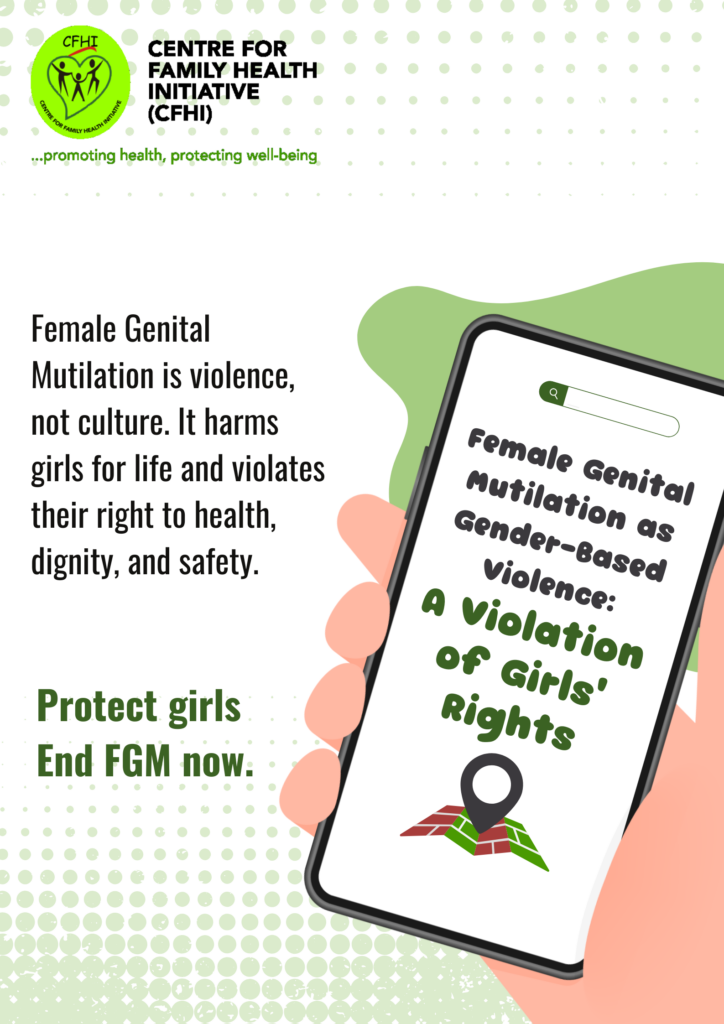
Female Genital Mutilation as Gender-Based Violence: A Violation of Girls’ Rights
Female Genital Mutilation (FGM) is a harmful traditional practice and a clear form of gender-based violence that fundamentally violates the human rights of girls and women. The World Health Organization defines FGM as all procedures involving the partial or total removal of the external female genitalia or other injury to female genital organs for non-medical reasons (1). The practice has no health benefits and causes lifelong harm, violating girls’ rights to health, bodily integrity, security, and freedom from cruel, inhuman, or degrading treatment (1).
Globally, more than 230 million girls and women alive today have undergone FGM, spanning at least 30 countries across Africa, the Middle East, and parts of Asia (1). Each year, an estimated 4 million additional girls remain at risk, most of them under the age of 15, highlighting the urgent need for accelerated action (1). These figures reflect not isolated incidents, but a sustained pattern of violence rooted in gender inequality.
FGM persists primarily because of unequal power relations and entrenched social norms that subordinate girls and women. In many communities, the practice is falsely justified as a cultural rite of passage, a prerequisite for marriage, or a means of controlling female sexuality. These beliefs reinforce the notion that girls’ bodies are subject to communal control rather than individual rights, a hallmark of gender-based violence (2).
FGM remains most prevalent in sub-Saharan Africa, with some of the highest rates recorded in Somalia (approximately 99%), Guinea (94.5%), and Djibouti (93%) among women aged 15–49 (3). In Nigeria, an estimated 19.9 million girls and women have undergone FGM, making it one of the countries with the highest absolute number of survivors globally (4). Prevalence varies significantly across regions, with higher rates reported in the South-East and South-West, including states such as Imo, where prevalence exceeds 60% in some communities (4). These statistics underscore how deeply embedded the practice remains at both national and sub-national levels.
As a form of violence, FGM is typically carried out without informed consent, often during childhood, and results in enduring physical, psychological, and social harm. Survivors frequently report anxiety, emotional distress, reduced self-esteem, and loss of bodily autonomy, which can persist throughout adulthood (5). The trauma associated with the experience often affects girls’ confidence, participation in education, and ability to form healthy relationships later in life.
Beyond psychological harm, FGM has serious implications for sexual and reproductive health. It increases the risk of complications during pregnancy and childbirth, contributes to maternal and neonatal morbidity, and places additional strain on already fragile health systems in low-resource settings (1). These consequences further affirm why FGM is recognized globally as both a public health crisis and a human rights violation.
Recognizing its severity, the international community has committed to eliminating FGM under Sustainable Development Goal (SDG) Target 5.3, with a global target year of 2030 (5). Agencies such as the World Health Organization (WHO) and UNICEF have led coordinated efforts focusing on legal reform, community engagement, survivor-centred health services, and prevention strategies that challenge harmful gender norms (6).
At the national level, progress has been uneven. In countries like Somalia, WHO and partners have supported health system reforms, professional training, and community-based interventions to address both FGM and broader gender-based violence (7). In Nigeria, UNICEF has supported community-led abandonment initiatives in high-prevalence states, mobilizing local leaders, families, and youth to protect girls at risk and shift social norms (4).
The impact of FGM on confidence and well-being cannot be overstated. Many survivors live with lasting psychological effects, including post-traumatic stress, fear, and diminished self-worth, which influence education, employment, and social participation (5). These invisible scars are often overlooked, yet they shape the life chances of millions of women and girls.
Ending FGM requires decisive, multi-level action. Governments must strengthen and enforce laws that criminalize the practice. Communities must be supported to challenge harmful norms through dialogue and education. Health systems must provide survivor-centred care, including mental health services. Men and boys must be engaged as allies in promoting gender equality, while robust data systems are needed to monitor progress and guide policy decisions. Only through sustained, coordinated action can FGM be eliminated, and girls’ rights fully protected.
FGM is not culture it is violence. Ending it is not optional; it is an urgent moral, public health, and human rights imperative.
References
- World Health Organization (WHO). Female Genital Mutilation.
https://www.who.int/health-topics/female-genital-mutilation - WHO Regional Office for Africa. Female Genital Mutilation.
https://www.afro.who.int/health-topics/female-genital-mutilation - UNICEF. New Statistical Report on Female Genital Mutilation.
https://www.unicef.org/png/press-releases/new-statistical-report-female-genital-mutilation-shows-harmful-practice-global - UNICEF Nigeria. FGM on the Rise Among Young Nigerian Girls.
https://www.unicef.org/nigeria/press-releases/unicef-warns-fgm-rise-among-young-nigerian-girls - UNICEF DATA. Female Genital Mutilation Statistics.
https://data.unicef.org/topic/gender/fgm/ - World Health Organization. New Recommendations to End Medicalized FGM.
https://www.who.int/news/item/28-04-2025-who-issues-new-recommendations-to-end-the-rise-in–medicalized–female-genital-mutilation-and-support-survivors - World Health Organization. Addressing FGM and GBV in Somalia.
https://www.who.int/about/accountability/results/who-results-report-2020-mtr/country-story/2023/improving-maternal-health-outcomes-by-addressing-female-genital-mutilation-and-gender-based-violence-in-somalia
Female Genital Mutilation as Gender-Based Violence: A Violation of Girls’ Rights Read More »