
Gender

SPEAK WEDNESDAY

WOMEN’S RIGHTS TO EDUCATION
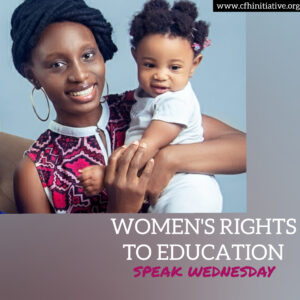
Education is a basic human right and has been recognized as such since the 1948 adoption of the Universal Declaration on Human Rights. Every one has the human right to education, training and information. Despite widespread agreement that all people have the fundamental human right to education, the United Nations Statistics Division states that 100 million children, with 60% of them being girls, do not have access to primary education. 960 million adults in the world are illiterate, and more than two-thirds of them are women. Women and girls continue to face discrimination at all levels of education, a fact which poses grave hindrance to their advancement. Equality of access to all levels of education is crucial to empowering women and girls to participate in economic, social and political life of their societies. Education unlocks a woman¹s potential, and is accompanied by improvements in health, nutrition, and well-being of women and their families.

According to the United Nations office of the high commissioner on Women and the right to education, it says: “Article 10 of the Convention on the Elimination of All Forms of Discrimination against Women, states that the right to education is the entitlement to access free primary education, and to have equal opportunities to continue with further studies. Such education must be inclusive and accessible to girls and boys, women and men, in law and in practice. Education is not only a right in itself, but is also the surest way to empower individuals to enjoy all of their human rights”.

Women in Nigeria have had various challenges in order to obtain equal education in all forms of formal education. Although more women and girls go to school today, the access to formal education is still being constrained especially in rural communities. They face multiple barriers based on gender and its intersections with other factors, such as age, ethnicity, poverty, and disability. Other barriers to access quality education include among others: harmful gender stereotypes and wrongful gender stereotyping, child marriage, early and unintended pregnancy, paid and unpaid care work which continues to be disproportionately borne by women and girls, gender-based violence against women and girls, lack of inclusive and quality learning environments, inadequate and unsafe education infrastructure, including sanitation.

Research shows that there is an improved health and an overall increase in quality of life of educated women. Educated women are more likely to seek proper medical care both for themselves, especially maternal care and their children. Likewise, higher rates of female education correspond with lower HIV and STD rates. There is a less occurrence of child marriages and teenage pregnancies if the prospects are educated. Many experts agree that focusing on women’s education is one of the best investments a developing nation can make, because female education rates are directly correlated with national economic growth. Educated women are more likely to hold stable jobs, less likely to be in poverty, and more likely to contribute to the overall economy.

Speak Wednesday is an initiative of Centre for Family Health Initiative to stop the cycle of domestic violence by breaking the silence around gender-based violence and gender bias. Join us every Wednesday on all our social media handles for more episodes.
SPEAK WEDNESDAY Read More »

SPEAK WEDNESDAY

WOMEN’S RIGHTS ON DOMESTIC VIOLENCE

The right of women to be free from DOMESTIC VIOLENCE has drawn increasing concern and support since the 1970s. According to Wikipedia, “Domestic violence (also named domestic abuse or family violence) is violence or other abuse in a domestic setting, such as in marriage or cohabitation. It takes a number of forms, including physical, verbal, emotional, economic, religious, reproductive, and sexual abuse, which can range from subtle, coercive forms to marital rape and to physical abuse.

Studies have shown that globally, domestic violence accounts for nearly one quarter of all recorded crimes. The fact that domestic violence prevails across all classes of the Nigerian society is no longer disputable. Despite the boisterous efforts made by the world bodies such as the United Nations (e.g. Universal Declaration of Human Rights, the International Convention on Civil and Political Rights) and Nigeria’s constitutions to eliminate discrimination and violence against women, and promote the idea of equality and justice, the Nigerian woman is often violated.

Domestic violence directed against women by intimate partners is an epidemic of global proportions that has devastating physical, emotional, financial and social effects on women, children, the family and the community. However, it is important to note that domestic violence can also be perpetrated against men.

In Nigeria, women’s rights are largely trampled upon because of many factors. There is the lack of trust in constituted authorities to look into cases of abuse. In fact, the “penal code of the northern Nigeria” do not recognize this as an act worth bringing before the law. It is rather seen as a compulsory disciplinary measure which to some uneducated traditionalists has proven to be very effective. Also, the requirements to prove rape cases in “section 179(5) of the evidence Actform another hurdle.

To promote gender equality and ensure protection of fundamental human rights, perpetrators should be made to face the consequences of their actions. Also, stiffer penalties have to be put in place to discourage prospective abusers like rapists. Over the years, Centre for Family Health Initiative (CFHI) has brought awareness to women in local communities on their rights and created avenues to seek redress in cases of abuse. It has also exposed many women to information about the Violence Against Persons Prohibition(VAPP) Act of 2015, for better understanding of their human rights.

Speak Wednesday is an initiative of Centre for Family Health Initiative to stop the cycle of domestic violence by breaking the silence around gender-based violence and gender bias. Join us every Wednesday on all our social media handles for more episodes.

SPEAK WEDNESDAY Read More »

SPEAK WEDNESDAY

WOMEN DEALING WITH EMOTIONAL ABUSE

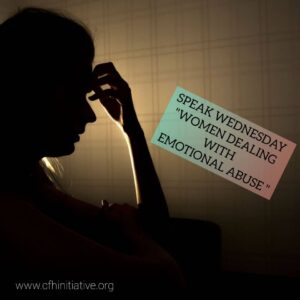
According to Tracy, N. (2012, July 29), emotional abuse is one of the most common forms of abuse that occurs in close relationships. It is also known as psychological abuse. Emotional abuse Is when something is consistently said, implied or done intentionally to hurt someone’s feelings over an extended period of time. It is about one person maintaining power or control over another person which usually takes place between intimate partners.

Emotional abuse can include verbal assault, dominance, privacy invasion, economic subordination,  control, isolation, gas lighting, ridicule, or the use of intimate knowledge for degradation. It targets the emotional and psychological well-being of the victim, and it is often a precursor to physical abuse. Studies show that women are at a disadvantaged point and have a higher chance of being abused emotionally due to the deep-rooted patriarchal nature of the society and of men controlling ‘their’ women.

Emotional abuse may be less obvious than physical abuse, but can still have devastating effects on the mental health and wellbeing of the victim. Effects of emotional abuse on women could be short or long-term. According to different reports, psychological or emotional abuse in women can be linked to poor relationship satisfaction, anxiety, depression, insomnia, low self-esteem, suicidal thoughts, increased physical health problems (such as migraine, indigestion, stomach ulcers, chronic pain and chronic disease), among others. Emotional abuse may be contributing factors to the development and/or severity of illnesses such as chronic fatigue syndrome and fibromyalgia.

Victims of emotional abuse often times feel embarrassed to report or open up about issues of emotional abuse especially those with no physical evidence. However, it is necessary to seek help or counselling either from a friend, a doctor or a relationship or family counsellor to avoid the adverse effects it may have on your general well-being.

Speak Wednesday is an initiative of Centre for Family Health Initiative to stop the cycle of domestic violence by breaking the silence around gender-based violence and gender bias. Join us every Wednesday on all our social media handles for more episodes.
SPEAK WEDNESDAY Read More »

SPEAK WEDNESDAY

WOMEN DEALING WITH SUICIDE

Wikipedia defines suicide as the act of intentionally causing one’s own death. Suicide is a public health problem, and it is seen as a public health priority by the World Health Organization (WHO). According to WHO, Suicide is the result of an act deliberately initiated and performed by a person in the full knowledge or expectation of its fatal outcome. Close to 800,000 people die due to suicide every year and it is considered the third leading cause of death in 15-19-year old.

Studies show that women make more suicide attempts than men, but men are more likely to die in the attempts than women. In Nigeria, most people do not believe depression is an illness, neither do they know the extent to which it affects the mind. Yet, between January and June 2019 alone, there were 42 reported cases of suicide that occurred in different parts of the country. An example is the story of Hikmat Gbadamosi, a 100-level student of the University of Port Harcourt, Rivers State. She was alleged to have consumed two bottles of insecticide (Sniper) after showing signs of depression and had opted to live away from her colleagues in the school.

According to Centre for suicide prevention, identified risk factor for suicide attempts and other suicidal behaviours in women include postpartum depression (PPD) affects around 15% of women and is experienced after giving birth and for up to one year after, prenatal period (The time during pregnancy and the first year after the birth of a child)- most women who die during this period have an affective or anxiety-related disorder, domestic violence (women experience partner violence nine times more than men according to different research) which in turn leads to post traumatic stress disorder (PTSD), and childhood sexual abuse. Other risk factors may include family history of suicide, family conflict, broken homes, anti-social behaviour, and poor peer relationships.

Suicide prevention begins with recognizing the warning signs and taking steps to make sure it does not happen. Though most people contemplating suicide often believe they are helpless, it is necessary to ask for external assistance, mostly a physician who can help find the medication or therapy that is suitable for the person. It is also important to take away harmful tools from their reach and make sure they are never left alone.

Speak Wednesday is an initiative of Centre for Family Health Initiative to stop the cycle of domestic violence by breaking the silence around gender-based violence and gender bias. Join us every Wednesday on all our social media handles for more episodes.
SPEAK WEDNESDAY Read More »

SPEAK WEDNESDAY

WOMEN DEALING WITH POVERTY IN RURAL AREAS

It is true that a concise and universally accepted definition of poverty has proven elusive because it affects many aspects of human condition. However, different criteria have been used to conceptualize the term “poverty”. Most analysts regard poverty as a function of income levels insufficient for securing basic goods and services.

The 2019 Nigerian Living Standards Survey (NLSS) carried out by the National Bureau of Statistics (NBS) highlights that 40 percent of the total population, or almost 83 million people, live below the country’s poverty line of 137,430 naira ($381.75) per year. The report also shows that 52.1% of rural dwellers in Nigeria are poor, while only 18.04% of urban dwellers are classified as poor. Also, according to data released by NBS, women ranked the highest when it comes to unemployment. The report shows that unemployment hits 12.2 million females as against 9.5 million men.

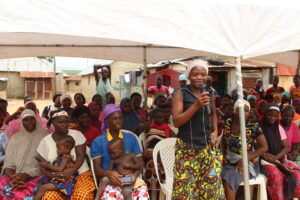
The fate of Nigerian women living in rural areas is highly appalling considering the patriarchal nature of the Nigerian society and how women are being marginalized in the labor force. The societal disadvantage and inequality they face because they are women shapes their experience of poverty differently from that of men, it increases their vulnerability, and makes it more challenging for them to climb out of poverty. Indeed, more than half of these rural women live below the nationally defined poverty line, lacking access to basic education, decent nutrition, adequate health and social services.  They perform complex multiple roles as mothers, workers and managers of households, taking care of their husbands, children and members of their extended families. They perform the majority of the work in food processing and dominate the rural and urban informal sector activities. Yet an abysmal number of these women own their own farm lands, they have limited access than men to inputs, services, rural organization, agricultural credits, productive infrastructure and technologies to enhance their productivity and incomes.

Women in poor households bear a disproportionate share of the work and responsibility of feeding and caring for family members through unpaid household work. They bear an unequal burden of unpaid, unrecognized, unvalued domestic responsibilities and are overrepresented in informal and risky jobs. Women in poor rural households will often sacrifice their own health and nutrition, or the education of their daughters, by recruiting them to take care of siblings or share in other household tasks.

This lack of investment in the human capital of women propagates a brutal, intergenerational cycle of poverty and hardship that is partly responsible for the persistent nature of poverty. Policies and programs to alleviate poverty must, therefore, take account of gender inequality and gender differences to effectively address the needs and constraints of women. According to the United Nations Women, Women’s economic empowerment is central to realizing women’s rights and gender equality, boosting productivity, increasing economic diversification, and income equality in addition to other positive development outcomes. This economic empowerment could include paid care work (child care, home care, seniors/disabled/palliative care), non-exclusion from inheritance and property ownership, girl child education and scholarships, adult education and scholarships for mothers, continued education during teenage pregnancy, provision of grants,  and many more.

Speak Wednesday is an initiative of Centre for Family Health Initiative to stop the cycle of domestic violence by breaking the silence around gender-based violence and gender bias. Join us every Wednesday on all our social media handles for more episodes.
SPEAK WEDNESDAY Read More »

SPEAK WEDNESDAY

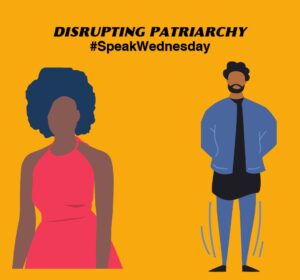
DISRUPTING PATRIARCHY

According to Wikipedia, Patriarchy is a social system in which men hold primary power and predominate in roles of political leadership, moral authority, social privilege and control of property. Some patriarchal societies are also patrilineal, meaning that property and title are inherited by the males only.

Patriarchy influences different areas of the society including culture, family, school, the workplace and relationships. Its presence can translate to inequality and gender-based violence. The idea of patriarchy is not peculiar to a specific group of people, but one that extends and supersedes all borders, socioeconomic class, race, and more.

In Nigeria, it is observed by different researchers including European Scientific Institute that . Hence, there is the commonality of general belief system that the best place for women is in the ‘Kitchen’. This trend has brought about tremendous misrepresentation of women right at the level of the family down to the circular society. Women are therefore discriminated upon from, in most cases, acquiring formal education, accessing proper health care, receiving equal pay, among others.

In so many parts of the world, women are forbidden to own landed properties or inherit any. In cases where the diseased did not have male children, his properties are distributed amongst his male relatives, excluding his widow and daughters who are left to fend for themselves. In these societies, women who are financially stable have to buy properties in the name of their fathers or other male relatives. All these expose women to violence before they are born until they are aged.

Zig Ziglar once said, the first step to finding a solution is to recognize there is a problem. Because of how ingrained patriarchy is in the society, it may be difficult to identify. However, if patriarchy can be learnt, it can be unlearnt. Together we can achieve a society with equal opportunities for all human irrespective of the gender differences.

Speak Wednesday is an initiative of Centre for Family Health Initiative to stop the cycle of domestic violence by breaking the silence around gender based violence and gender bias. Join us every Wednesday on all our social media handles for more episodes.
SPEAK WEDNESDAY Read More »

SPEAK WEDNESDAY

FEMALE ROLES IN POLICY MAKING

Policies are deliberate systems enacted by those in positions of authority to define the rules, standards, regulations, and procedures that affect almost every aspect of human life such as education, health, agriculture, migration, aviation, finance, defence, environment, trade, justice, transportation, science and technology.

Valentina Tereshkova quotes, a bird cannot fly with one wing only. Human space flight cannot develop any further without the active participation of women. Yet, for several decades, the society encouraged male dominance and totally excluded women from occupying positions that influence key decision making processes. Forgetting that making policies without the contribution of women may not adequately reflect the needs and preferences of women, youths, and children.

Ngozi Okonjo-Iweala is a Nigerian-born economist and international development expert who during her tenor as the Minister of Finance for Nigeria, helped the country’s economy grow an average of 6% (per annum) over three years. She is credited with developing reform programs that helped improve governmental transparency and stabilizing the economy. Another example is Angela Merkel, who transformed German politics since being voted into office in 2005. Her numerous achievements at home and abroad have seen her top Forbes’ most powerful women list eight times.

A Member of Parliament in Rwanda, Thacienne Dusabeyezu once said, “The more women in the parliament, the better it is for children”. This is because women are generally more attached to children than men and they understand the needs of children. Hence, are more likely to enact child-friendly policies.

The role of women in policy making and implementation is essential in every society to help advance gender equality. Most women elected to be in the parliament will place women concerns and rights at the forefront of their agendas, suggesting policies that would promote women and speaking against policies that abuse women rights and deter their development.

Senator Kirsten Gillibrand of New York said that to fix the gridlock in Congress, more women should be involved. This is because women are more focused on finding common ground and collaborating. Women are characterized by tenderness, love, care, creativity, innovation, reliability, and if more women are key decision makers, perhaps organizations could respond effectively to challenges before the challenges are escalated to bigger problems.

It is inappropriate to ignore the intellectual capital resource of over half the population of the world.  To address global injustice and advocate for compassionate policies, both men and women must recognize the value of a balance in government. Women should not simply emulate the male role model, but should bring their own principles to every negotiating table.

Speak Wednesday is an initiative of Centre for Family Health Initiative to stop the cycle of domestic violence by breaking the silence around gender based violence and gender bias. Join us every Wednesday on all our social media handles for more episodes.
SPEAK WEDNESDAY Read More »

SPEAK WEDNESDAY

FEMALE ROLES IN COMMUNITY DEVELOPMENT

According to Paul O’Neill, a good community is a cohesive, safe, confident, prosperous and happy place. A place that values and promotes open, participative development processes underpinned by a continuous culture of trans-generational learning. It is somewhere that people wish to stay in and see future generations grow up in.

Community development is almost impossible without the role of women both at the family level and in the society. Women are said to be the first teachers in the lives of every child, and whatever is embedded in the child springs forth to determine if the child will be responsible and patriotic citizen or otherwise.

As the society moves closer to gender equality, women are working to build a more substantial presence in the traditionally male-dominated industries. Women have grown from being relegated to the kitchen or bedroom, to taking up jobs that are supposedly designed for men. United Nations Women opined that not only has this contributed greatly to the economic growth of the community but has created a niche for future generations to strife. Some of these women are entrepreneurs, employing male and females alike.

Late Ameyo Stella Adadevoh is a Nigerian physician credited for curbing the wider spread of the Ebola Virus in Nigeria by placing the patient, Patrick Sawyer in quarantine despite pressure from the Liberian government. Women who are frontline health workers are fighting the war to eradicate COVID-19, and others who are human right activists work passionately to protect the rights of people in communities and taking up positions to tackle issues that affect the masses.

The role of women in community development can never be overemphasized. Therefore, to increase the efficiency and productivity of women in the communities, women should be appreciated and encouraged to do more.

Speak Wednesday is an initiative of Centre for Family Health Initiative to stop the cycle of domestic violence by breaking the silence around gender based violence and gender bias. Join us every Wednesday on all our social media handles for more episodes.
SPEAK WEDNESDAY Read More »

MONDAY HEALTH BURST

MOTHER TO CHILD TRANSMISSION OF HIV DURING BREASTFEEDING

Human Immunodeficiency Virus (HIV) is a virus that attacks the body’s immune system and is spread through the blood and certain body fluids, including breast milk. Mother-to-child transmission of HIV is the primary mode of HIV infection in infants. If neither the mother nor baby is on consistent HIV treatment, there is a high chance that the baby will be infected through breastfeeding.

Several factors can increase the risk of perinatal transmission. Having a high viral load implies that the white blood cells (CD4) which provides immunity to the body is low. A viral load indicates how much of the HIV is present in the body of an infected person. A high viral load may mean a recent HIV transmission, an untreated or uncontrolled HIV. Positive pregnant women and breastfeeding mothers with a CD4 count lower than 200 are at a greater risk of transmitting the virus to their infants.

HIV screening is essential during antenatal appointments at any health centre to ascertain the HIV status because the earlier the virus is detected the better the chances of living longer and enjoying a normal life. Test should also be repeated every three months and a Post Exposure Prophylaxis (PEP) should be received if exposed to an infected blood within forty eight hours.

Accumulating evidence has also shown that giving antiretroviral medicines to the mother or the infant can significantly reduce the risk of HIV transmission through breastfeeding. Antiretroviral prophylaxis should be made available to HIV infected mothers and mothers-to-be in all health settings and should be administered to HIV exposed infants immediately after birth. The duration for antiretroviral care and treatment for the infant is dependent on the mothers’ choice of feeding either exclusive breast feeding or replacement feeding. However, World Health Organisation recommends HIV infected mothers to only do exclusive breastfeeding except replacement feeding is acceptable, feasible, affordable, sustainable, and safe. Mixed feeding on the other hand is strongly discouraged as a breastfeeding option for reactive mothers.

All exposed infants should be tested for HIV at birth, at six (6) weeks and eighteen (18) months. This is done to monitor the HIV status of the newborn.

Monday Health Burst is an initiative of Centre for Family Health Initiative (CFHI) to tackle issues of basic health concerns. Join us every Monday for more health related articles on all our social media platforms.


MONDAY HEALTH BURST Read More »

SPEAK WEDNESDAY

GENDER ROLES IN LEADERSHIP

With the increasing interventions and awareness to promote equal rights and opportunities for boys and girls in Africa, more females are raising their voices against gender inequality. Women are now asserting their power as global ground breakers dominating fields and positions of leadership that were exclusively reserved for men. Women are seizing opportunities and attaining heights of success.

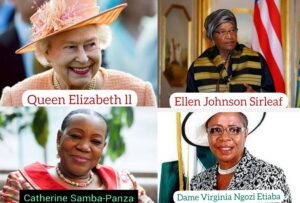
Around the world, women are leading countries. Queen Elizabeth II of the United Kingdom has been the reigning queen since 1952. Africa is not left out. Ellen Johnson Sirleaf was the first elected female head of state in Africa. She served as the President of Liberia from 2006 to 2018. Catherine Samba-Panza served as interim President of the Central African Republic from 2014 to 2016. She was the first to hold that position in the country. Dame Virginia Ngozi Etiaba served as the governor of Anambra State, Nigeria, from 2006-2007.

Anyone irrespective of gender who possesses leadership skills and qualities can be a leader. Thus, men and women show distinct leadership traits and qualities. Many argue that women cannot withstand the challenges that come with leadership because their biological formation detests stress and pressure.  Women are judged to be reserved and soft so they can be easily swayed. Well, these qualities are more of strengths than weaknesses. The soft nature of women makes them considerate leaders that listen to the plight of the masses and strive to protect the interest of the people they serve. This is a unique leadership quality called selflessness.

Compassion is an asset every leader must possess. A leader must be compassionate, deferential, submissive, self-effacing, and treat everyone with the same level of dignity. A compassionate and humble leader will learn from others and accept mistakes because he/she is not all knowing. Women are not just compassionate and humble, they are innovative, creative, and logical thinkers. Selecting leaders based on these attributes would definitely produce more female than male leaders. These attributes earn female leaders the collaboration and cooperation of the followers to advance for a better future.

Women led nations seem to be particularly successful in fighting COVID-19. New York Times reports that the Chancellor of Germany, Angela Merkel has had fewer death rates than France, Italy and Spain. 34 year old Sanna Marin who is the Prime Minister of Finland with collaboration of 4 female led parties has had far lower deaths than nearby Sweden. Without a total national lock down, Tsai Ing-wen the female president of Taiwan has achieved one of the most successful efforts in the world at containing Corona Virus.

Women should be given more opportunities to occupy positions of leadership. Instead of criticizing the leadership abilities of women, men should be encouraged to embrace unique leadership traits of women leaders. The world will advance for the better when this is achieved.

Speak Wednesday is an initiative of Centre for Family Health Initiative to stop the cycle of domestic violence by breaking the silence around gender-based violence.  Join us every Wednesday on all our social media handles for more episodes.

SPEAK WEDNESDAY Read More »