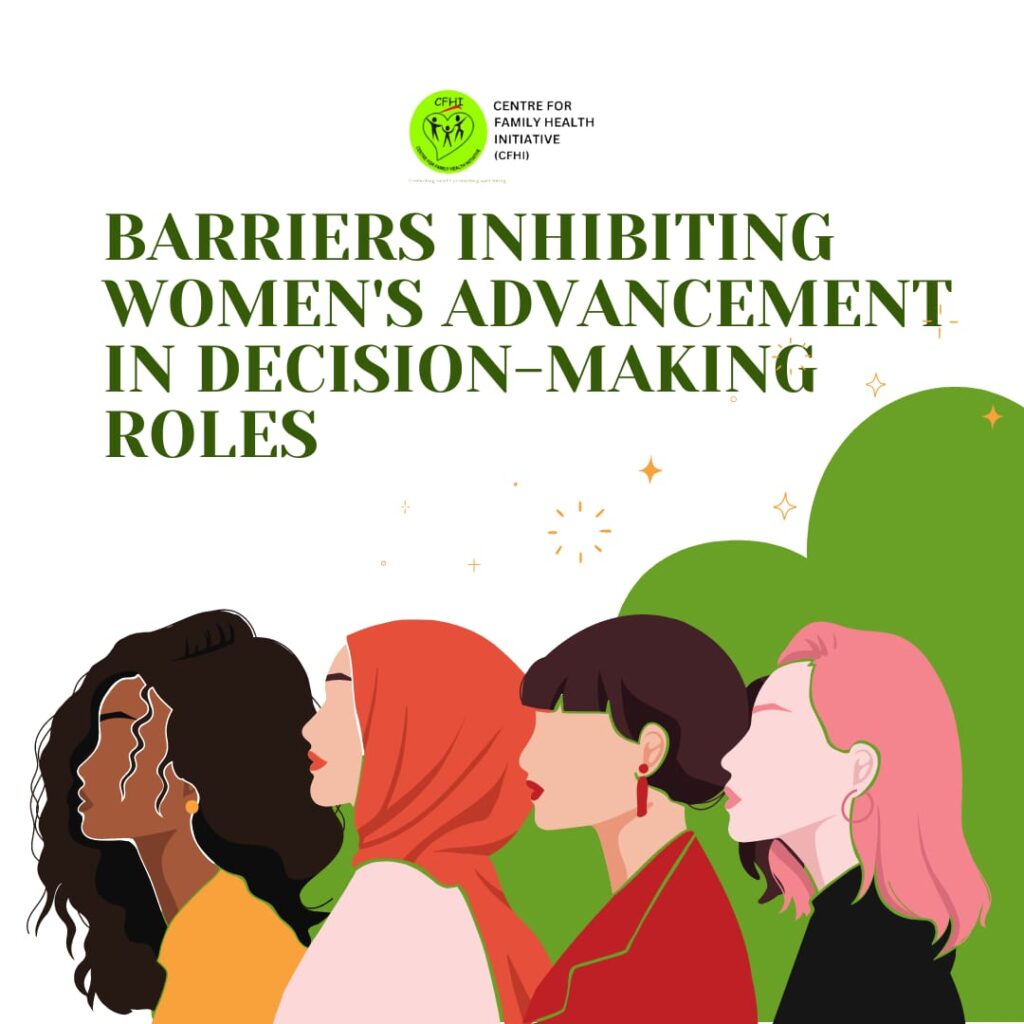
SPEAK WEDNESDAY ON BARRIES INHIBITING WOMEN’S ADVANCEMENT IN DECISION-MAKING ROLES
In recent decades, significant strides have been made toward gender equality in various spheres of life. However, despite these advancements, a substantial gender gap persists when it comes to women’s representation in decision-making roles across industries and sectors. The underrepresentation of women in positions of power and authority, particularly in decision-making capacities, remains a complex and concerning issue. Gender discrimination impedes women’s advancement in decision-making roles, economic empowerment, safety, and autonomy, which has an impact on the country’s GDP and economy. These stereotyping and unconscious biases are barriers to obtaining gender balance. They are also linked to larger sociological, political, economic, and governance issues. Furthermore, internal hurdles within women, along with insufficient leadership support, add to the imbalance. In Nigeria’s Senate and House of Representatives, men hold 96.5% of the 423 seats, while women only have 3.5%. In addition, during the recent Ministerial screening, out of 48 seats, less than 16% were occupied by women.
The primary factors contributing to the underrepresentation of women include:
A lack of effective government action;
Lower levels of female employment and education;
Sexism, sometimes but not always deriving from religion or traditional practices;
A corrupt and patronage-based political system;
Violence at elections, including against women candidates.
Additionally, within the professional sphere, despite notable growth in the number of women occupying middle management positions over the past two decades, the proportion of female Chief Executive Officers within major corporations remains remarkably low. This discrepancy can be attributed to a variety of factors, including:
Inadequate exposure to line management roles.
Limited access to promising career paths.
Gender-related variations in linguistic styles and socialization.
Prevalent gender-based stereotypes.
The persistence of established networks favouring male advancement.
Superficial inclusion efforts, often referred to as tokenism.
However, this can be addressed with conscious efforts by the government, civil society, international organizations, and individuals. By deliberately and cooperatively addressing gender discrimination barriers in Nigeria through policy reforms, transformation of discriminatory cultural norms, provision of funds, mentoring, and leadership training, women can attain greater participation and prosper in leadership roles.
According to the UNDP, gender equality (Goal 5) will help to enable women’s full and effective involvement and equal chances for leadership at all levels of decision-making in political, economic, and public life.
Speak Wednesday is an initiative of CFHI to address issues around gender-based violence and gender bias.
#SpeakWednesday #GenderEquality #GenderDiscrimination #WomenInLeadership
REFERENCES
Kelly, L. (2019). Barriers and enablers for women’s participation in governance in Nigeria. K4D Helpdesk Report. Brighton, UK: Institute of Development Studies.
Oakley, J.G. Gender-based Barriers to Senior Management Positions: Understanding the Scarcity of Female CEOs. Journal of Business Ethics 27, 321–334 (2000). https://doi.org/10.1023/A:1006226129868
Kayode Oyero. (2023). #IWD2023: Women Get 15 Out Of 423 Senate, Reps Seats.
https://www.channelstv.com/2023/03/08/iwd-women-get-15-out-of-423-senate-reps-seats/
SPEAK WEDNESDAY ON BARRIES INHIBITING WOMEN’S ADVANCEMENT IN DECISION-MAKING ROLES Read More »