cfhinitiative

SPEAK WEDNESDAY – MOTHERHOOD PENALTY

After childbirth, most women experience a significant drop in their careers. This is called the motherhood penalty.

According to Wikipedia, the motherhood penalty is a term coined by sociologists who argue that in the workplace, working mothers encounter biological and cultural-based disadvantages in pay, perceived competence, and benefits relative to childless women.

Mothers in the workforce most times face discrimination in the hiring process based on stereotypical views that women are less committed to their work, therefore less productive. Subsequently, this affects the employability rate of women, wages, evaluations, promotions, and in a long run, their careers.  

To change the narrative, the government should make policies that prohibit discrimination against mothers, continue to promote paid parental leave, and assess gender wage gaps. Society and employers should learn to provide support for working mothers as that will reduce the penalization of women for starting a family.

Speak Wednesday is an initiative of CFHI to address issues around gender-based violence and gender bias. Join us every Wednesday on all our social media platforms for more episodes.


# SpeakWednesday #MotherhoodPenalty #GenderBias #Genderinequality

SPEAK WEDNESDAY – MOTHERHOOD PENALTY Read More »

MONDAY HEALTH BURST – VIRAL HEPATITIS IN NIGERIA

Viral hepatitis is one of the most communicable diseases in the world. It is spread through contaminated blood, intravenous drug abuse and sexual contact with an infected person. In highly endemic areas like sub-Saharan Africa and Asia, hepatitis B is most commonly spread from mother to child at birth (perinatal transmission). In addition, infection can occur during medical, surgical and dental procedures, tattooing, or through the use of razors and similar objects that are contaminated with infected blood. Annually, viral hepatitis affects 400 million people worldwide, causing acute and chronic liver diseases and killing about 1.5 million people (4,000 people daily), mostly from hepatitis B and C. Yet, it is entirely preventable.

Infection with hepatitis B virus (HBV) or hepatitis C virus (HCV) is the main cause of liver cancer. According to Centre for Disease Control (CDC), viral hepatitis causes 80% of all liver cancer deaths. In Nigeria, liver cancer is the second leading cause of cancer deaths, accounting for over 11,000 deaths yearly and 32 deaths every day. Liver cancer is less common among children and teenagers and more common with adults. The average age of occurrence in Nigeria is about 46 years compared to the developed world where the average age of occurrence is in the mid-60s. Also, liver cancer is more common in men with a male: female ratio of about 2 in 1 according to National Center for Biotechnology Information (NCBI). Liver cancer is rare in children and teenagers.

Every year, July 28 is marked as World Hepatitis Day (WHD). It is a day dedicated to increase the global awareness and understanding of viral hepatitis and the diseases that it causes. This is because research shows that with better awareness and application of its preventive measures, this life-threatening disease could be eliminated, and 4,000 lives could be saved daily.

Centre for Family Health Initiative (CFHI) takes advantage of this special event annually to work towards eliminating viral hepatitis across different states in Nigeria. Aside awareness creation in communities by CFHI, other successful ways employed to curb this menace is to reach out to key populations in Abuja, Nasarawa and Imo states with sensitization programs, vaccination and referrals. These key populations include female sex workers, drug addicts, inmates in correctional centres, worship centres, and people living in hard-to-reach communities. CFHI also carries out street interviews to know the level of awareness of people towards hepatitis and has over the years reached out to over 1000 people.

During the sensitization campaigns, participants are shown different ways of preventing the transmission of viral hepatitis, which include avoiding sharing of needles and other items such as toothbrushes, razors or nail scissors, avoiding tattoos or body piercings from unlicensed facilities and screening of blood donation products, practicing safe sex by minimizing the number of partners and using barrier protective measures (condoms), reducing alcohol intake, obesity, and avoiding aflatoxin prone foods like tree nuts (almonds, cashews, and walnuts), peanut, rice, corn, dried fruits, cereals, among others.

During the street interviews by CFHI, about 40% of the respondents were unaware of what hepatitis really is, neither do they know the means of transmission and preventive measures; 30% agreed to have heard about hepatitis, but never cared much about it; 20% were either infected or affected by HBV or HCV; and 10% had proper knowledge of viral hepatitis and were vaccinated.

To significantly reduce the current hepatitis epidemic, screening and early diagnosis still remains a major tool in preventing transmission of viral hepatitis and other health problems that may result from viral hepatitis infection. There is need for massive awareness and widespread availability of these interventions. With CFHI already facilitating health education, screening as well as vaccination against hepatitis at the grassroots and among key populations, a larger number of persons in Nigeria will be reached with more support.

Follow us on all our social media handles for updates on the commemoration of World Hepatitis Day, 2022.

MONDAY HEALTH BURST – VIRAL HEPATITIS IN NIGERIA Read More »

Speak Wednesday- Structural Inequality in Rural Communities

Structural inequality is a situation when social institutions offer a biased distinction which is advantageous to certain category of people and marginalizes some other set of people. In this case, the women. This marginalization is mainly a rural phenomenon. However, urban communities are not completely excluded.

The structural gender inequality persists in rural communities due to factors such as sexual orientation, tradition and religion. As a result of this, some women in rural communities are denied equal access to wealth, properties, wages, quality education, good health care and health insurance, employment, living standards, among others. Which is detrimental to the actualization of sustainable development goals and frustrates the economic growth of the society at large.

To combat structural gender inequality in rural communities, all private sectors should encourage maternity leaves with pay. Also, the government should without gender bias increase the minimum wage, end residential segregation, build affordable assets for working families, invest in infrastructure and public services, ensure the fair distribution and access to land, and end all forms of discrimination.

Speak Wednesday is an initiative of CFHI to address issues around gender-based violence and gender bias. Join us every Wednesday on all our social media platforms for more episodes.

#SpeakWednesday #StructuralInequality #GenderBias #RuralCommunities #Urbanization

Speak Wednesday- Structural Inequality in Rural Communities Read More »

Monday Health Burst – Prevention of Mother-to-Child Transmission of HIV

In 2020, 1.7 million people in Nigeria were living with HIV (human immunodeficiency virus), according to National Agency for the Control of AIDS (NACA). Women being the most affected group, numbering about 960 thousand. Agreeably, this puts children at a very high risk of infection.

According to World Health Organization (WHO), HIV can be transmitted from infected pregnant woman to her infant during pregnancy to breastfeeding periods. However, with effective medical intervention, the rate of maternal to child transmission of HIV can be curtailed.

Some of the interventions include the sensitization of isolated communities and youths to the dangers of having unprotected sex, guidelines for HIV prevention, care and treatment for infected pregnant women, among others. Also, intensifying prevention of mother-to-child transmission (PMTCT) programmes in health care centres.

#MondayHealthBurst #PMTCT #Health4All #HIVAIDSPrevention

Monday Health Burst – Prevention of Mother-to-Child Transmission of HIV Read More »

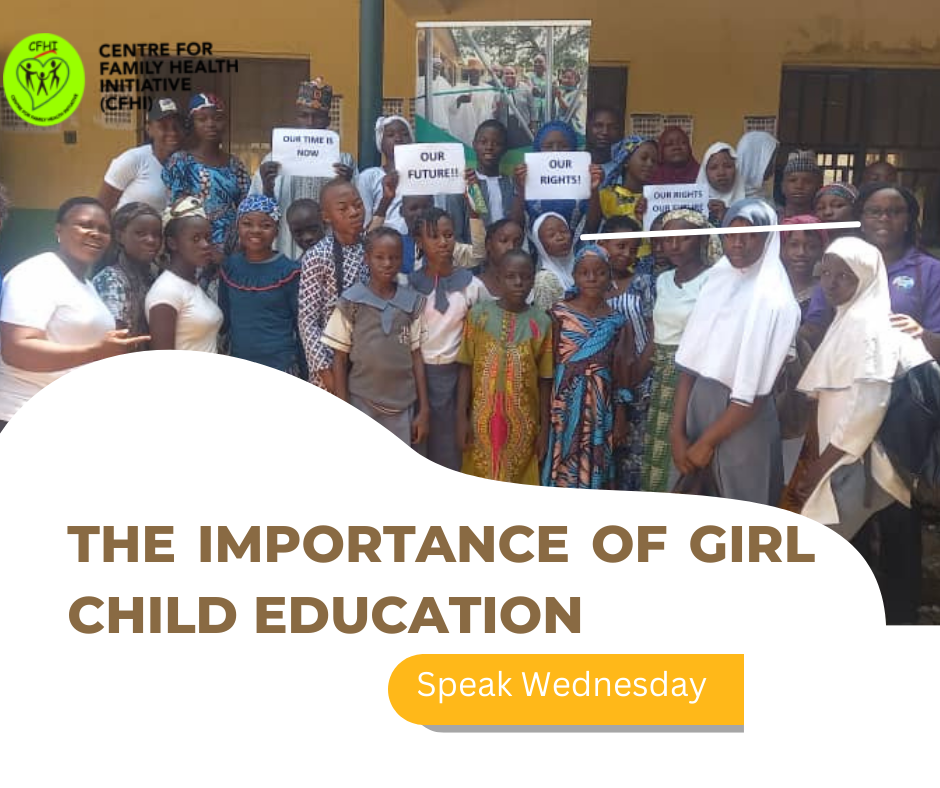
SPEAK WEDNESDAY – GENDER INEQUALITY IN GIRL CHILD EDUCATION

Gender inequality in education is a sociocultural bias that entails unequal participation of girls as their male counterparts in education. This is a national concern that has been continuously overlooked by the government.
The discriminatory treatment against girls who are most times burdened with household responsibilities, like cooking, cleaning, tending to the garden, fending for their siblings, etc has led to a great perception against the girl child education.
 
In some families, the girl child is sometimes engaged in child labour like helping her parents in trading to raise money for her brother’s education, while the girl is believed to be married off to another family, hence remains uneducated.
 
The factors causing gender equality against girls in education are illiteracy, poverty, poor infrastructure, discriminatory gender norms, child marriage, gender-based violence, and cultural harmful practices, among others.
 
In rural communities, the saying that a girl’s education ends in the kitchen is still upheld by some families who believe educating a girl is a waste of money. This is a traditional viewpoint regarding the education of girls in some places in Nigeria, yet, in this 21st century.
 
According to UNICEF, gender-equitable education systems empower girls and boys and promote the development of life skills – like self-management, communication, negotiation, and critical thinking that young people need to succeed. They close skills gaps that perpetuate pay gaps and build prosperity for entire countries.
Gender-equitable education systems can contribute to reductions in school-related gender-based violence and harmful practices, including child marriage and female genital mutilation.
 
To overcome barriers that are preventing girls from advancing equally with boys in education, the government should promote gender-responsive programs and a safe learning environment that prioritizes girls’ education. Also, teachers should be trained to be gender aware to prevent gender stereotypes and reduce gender bias in the classroom.
 
The girl child should be allowed the same opportunity as their male counterparts to complete their education to enable them to navigate and acclimatize to the fast-changing world. It is one of their basic fundamental rights, as children.
 
Speak Wednesday is an initiative of CFHI to address issues of gender-based violence and gender bias. Join us every Wednesday on all our social media platforms for more episodes.

SPEAK WEDNESDAY – GENDER INEQUALITY IN GIRL CHILD EDUCATION Read More »

SPEAK WEDNESDAY-CHILD ABUSE

Section 28 of the Child Rights Act provides that no child shall be subjected to any forced or exploitative labour; or employed to work in any capacity where he is employed as a domestic help outside his own home or family environment.

Child labour refers to the permissible and non-permissible work done by children for a third party or an employer, which is sometimes done in hazardous situations. It is, however, important to note that this does not include reasonable household chores carried out by children under supervision in their homes which is a primary part of training children to be responsible adults in the future.

In Nigeria, child labour has persisted due to extreme poverty, lack of access to quality education, poor economic growth and the societal attitude towards child labour. Regardless of the existing laws prohibiting the practice, children are being pushed into domestic work daily just to bring additional income to support the family while facing exposure to sexual exploitation and other hazards associated with child abuse.

According to ILO, estimates determine that the current number of child workers in Nigeria is 15 million, which shows that Nigeria has the highest number of child labour in West Africa. The effects of child labour on children include both bodily and mental harm, poor or zero education, sexual or economic abuse, and other violations of child’s rights.

To eliminate domestic child labour in Nigeria, the problem of poverty should be tackled first by an overhaul of the economy to provide jobs for adult citizens of the country. Education should be made free for children from primary to secondary levels to keep children in school and lessen the financial burden on families. Also, the government should implement laws like the Child Rights Act and the Labour Act to foster the protection of children from exploitation.

Speak Wednesday is an initiative of CFHI to address issues around gender-based violence and gender bias. Join us every Wednesday on our social media platforms for more episodes.

#SpeakWednesday #ChildLabour #DomesticViolence #SDGs #EndChildLabour #PurnishPerpetrators

SPEAK WEDNESDAY-CHILD ABUSE Read More »

Period Poverty_MHM

SPEAK WEDNESDAY – PERIOD POVERTY AND POOR EDUCATION

The backdrop in girls’ education due to lack of menstrual hygiene in Nigeria should no longer be gender issue, but of national concern.

The National Democracy and Health Survey in 2013 has shown that girls make up 60 per cent of the 110.5 million out-of-school children in Nigeria, and 1 in 10 African girls misses school due to their period, according to UNICEF. In order words, they could miss school for four days or more during which the period lasts, and since they cannot manage their period safely without a good sanitary product, such children are most likely to drop out of school in the long run. Moreso, the hike in menstrual products has left most Nigerian girls and young women with no choice but to use unclean napkins, tissue, leaves, newspapers, or nothing at all, during their menstruation.

The old African proverb says “educate a girl, educate a nation”. To curb this damaging menace caused by period poverty, the Nigerian government should borrow a Leaf from Kenya’s policy which introduced the right to free, sufficient and quality sanitary towels, and basic sanitation facilities for schoolgirls; treating access to sanitary pads as a basic human right. This and the total removal of tax on menstrual products will help to make the girl child stay in school during their monthly flow.

Like Michelle Obama rightly said, when girls are educated, their countries become stronger and more prosperous. It is time to embrace this fact and work towards creating a world where everyone irrespective of gender can thrive without limitations.

Speak Wednesday is an initiative of CFHI to address issues of gender-based violence and gender bias. Join us every Wednesday on all our social media platforms for more episodes.

#SpeakWednesday #MenstrualRightsAwareness #MenstrualHygiene #MenstrualEquality #GirlsInSchool #EquityAndJustice #MHDay2022 #WeAreCommitted
#reusablesanitarypad

SPEAK WEDNESDAY – PERIOD POVERTY AND POOR EDUCATION Read More »

Say No To FGM

Speak Wednesday – Female Genital Mutilation

Following the expository overview of the practice of female genital mutilation (FGM) last week, there is no gainsaying the fact that FGM has no health benefits for girls and women, but rather constitutes a major risk for women and children who are affected.

Today on Speak Wednesday, we will be discussing one of the long-term complications of FGM which is child delivery complications. There is a high probability that women with FGM tend to experience complications during childbirth. This depends on the type of FGM, meaning the more severe the type of FGM, the more serious the complications.

A study coordinated by @WHO in 28 obstetric centres in 6 African countries including Nigeria shows that deliveries of women who had undergone genital mutilation were significantly more likely to be complicated by caesarean section, postpartum haemorrhage, and prolonged maternal hospitalization than those of women who had not.

Besides being associated with childbirth complications, FGM could lead to obstetric complications that can result in a higher incidence of infant resuscitation at delivery and intrapartum stillbirth and neonatal death.

There is no justifiable reason for FGM. It is a crime against nature’s integrity and a violation of human right, with the risk of causing trauma and leading to problems related to girls’ and women’s mental health and well-being. (WHO,2020)

#EndFGM #SpeakWednesday

Speak Wednesday – Female Genital Mutilation Read More »

MONDAY HEALTH BURST – HIV/AIDS Common Myths and Facts

On today’s Monday Health Burst, find out some HIV/AIDS common myths and facts. This topic is of great importance to the ending of AIDS because false myths arise due to lack of facts or having inaccurate information.

Myth 1: HIV can be cured.

Fact: There’s no cure yet for HIV, but antiretroviral treatment

Myth 2: I can get HIV by being around people who are HIV-positive.

Fact: HIV is not spread through touch, tears, sweat, saliva, or urine

Myth 3: Mosquitoes spread HIV.

Fact: Several studies show that mosquitoes do not spread HIV, even in areas with lots of mosquitoes and cases of HIV.

Myth 4: I don’t need to worry about getting HIV. Drugs will keep me well.

Fact: Antiretroviral drugs (ART) improve the lives of many people who have HIV and help them live longer. But many of these drugs are expensive and have serious side effects. Prevention is cheaper and easier than managing a lifelong condition and the problems it brings.

Myth 5: I am HIV-positive. My life is over.

Fact: ART allows people with HIV or AIDS live longer, normal, and productive lives when taken correctly and in time. One may live as long as s/he would have without the virus.

Myth 6: Now that I have HIV, I can’t have kids.

Fact: When pregnant, a doctor will prescribe HIV drugs to protect the mother and baby. The baby may also be given medication after birth. This will help protect the baby from being infected with the virus.

Myth 7: HIV is a spiritual curse.

Fact: HIV is not a spiritual curse, it is a disease contracted via unprotected sex, sharing of infected sharp objects, blood transfusion, exchange.

Join us next week on #MondayHealthBurst as we shall be discussing Pre-Exposure Prophylaxis (PrEP).

MONDAY HEALTH BURST – HIV/AIDS Common Myths and Facts Read More »

SPEAK WEDNESDAY – PREDIABETES

PREDIABETES – YOUR CHANCE TO PREVENT TYPE 2 DIABETES

According to Centre for Disease Control (CDC), prediabetes is a serious health condition where blood sugar levels are higher than normal, yet not high enough to be diagnosed as type 2 diabetes. If one has prediabetes, it shows that the cells in the body do not respond normally to insulin. Hence, the pancreas makes more insulin to try to get cells to respond and eventually will not be able to keep up. The blood sugar then rises, setting the stage for prediabetes and type 2 diabetes.

Studies have shown that 1 in 3 American adults have prediabetes. In Nigeria, the prevalence of prediabetes is also high with hypertension emerging as the possible driving force. Though the exact cause of prediabetes is unknown, family history, genetics, lack of regular physical activity and being overweight with excess fat around the abdomen appear to be important factors. Other factors include ever having gestational diabetes (diabetes during pregnancy) or giving birth to a baby who weighed more than 9 pounds and having polycystic ovary syndrome.

Often times, one could be with prediabetes for years with no clear symptoms, so it often goes undetected until serious health problems such as type 2 diabetes show up. However, some people experience increased thirst, frequent urination, excess hunger, fatigue, blurred vision, and darkened skin on certain parts of the body (neck, armpits, elbows, knees and knuckles).

To reverse prediabetes, keep an active lifestyle by getting at least 150 minutes a week of brisk walking or a similar activity, avoid refined carbohydrates, cut back on sugar, eat healthy foods, drink less alcohol, get sufficient sleep, reduce food portion size. More so, periodic screening is key to detecting and reversing prediabetes. Simple Blood Sugar Test done in time could stop prediabetes from developing into type 2 diabetes, heart disease, and stroke.

SPEAK WEDNESDAY – PREDIABETES Read More »