
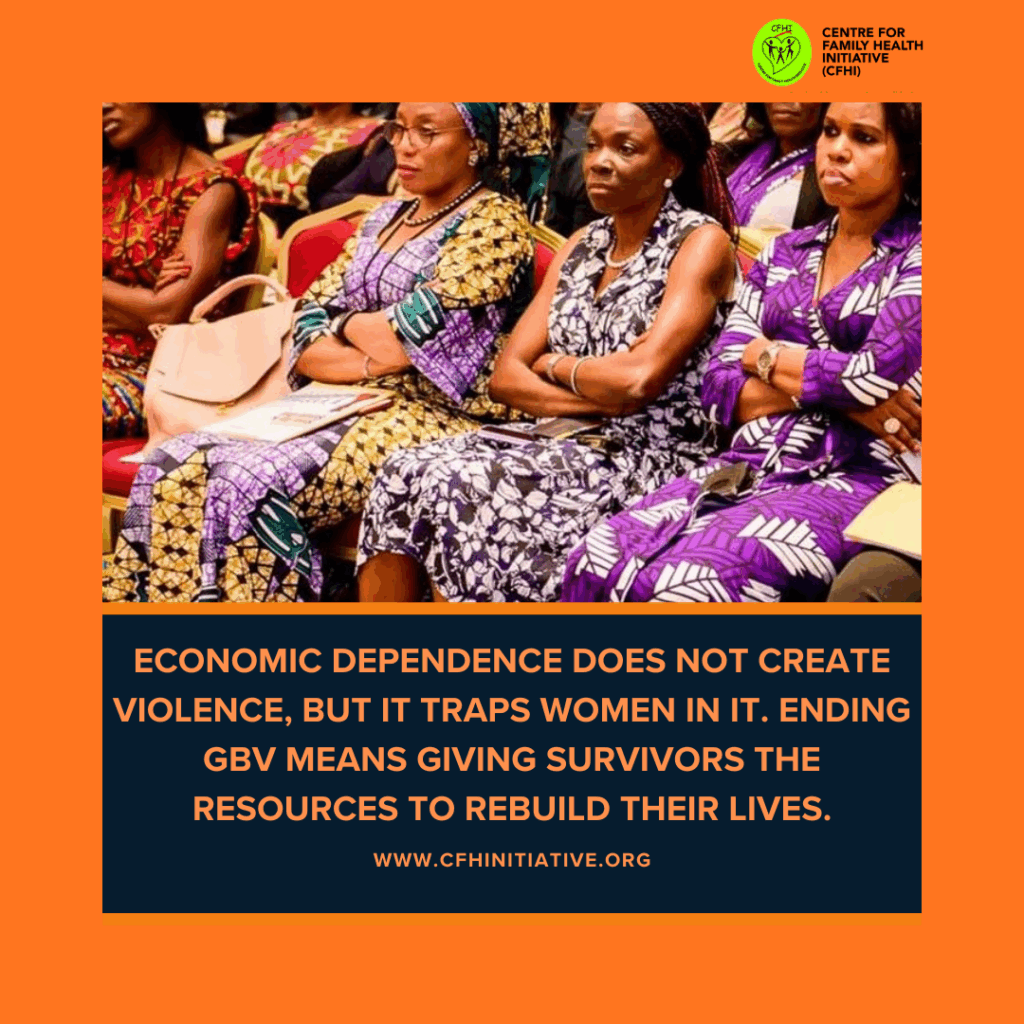
Economic Dependence and Poverty
Economic dependence and poverty are not just financial issues they are powerful forces that shape power dynamics, influence decision-making, and, far too often, trap women and girls in cycles of gender-based violence (GBV). As the world marks the UN 16 Days of Activism Against Gender-Based Violence, it is essential to spotlight how economic injustice fuels abuse and limits survivors’ ability to break free.
Globally, 1 in 3 women experience physical or sexual violence in their lifetime [1]. But this statistic tells only part of the story. Economic vulnerability magnifies the risk. According to UN Women, women who lack income or financial independence are more than twice as likely to experience intimate partner violence (IPV) compared to women with stable earnings [2]. Poverty does not cause violence, but it creates the conditions that allow it to thrive.
Women and girls in low-income settings often face restricted access to education, limited job opportunities, lower wages, and discriminatory cultural norms that position men as sole decision-makers. In many African countries, including Nigeria, the gender wage gap persists, and only 47% of women participate in the labor force compared to 74% of men [3]. Economic dependence becomes both a weapon and a barrier abusers use financial control to dominate, and survivors stay because they have nowhere else to go.
Research also shows that economic abuse such as preventing a woman from working, taking her earnings, or denying access to financial resources is present in 94% of abusive relationships [4]. This form of violence is silent but devastating. It keeps survivors trapped in relationships where they fear not only physical harm, but homelessness, hunger, and inability to care for their children.
During the 16 Days of Activism, the global community emphasizes prevention, protection, and justice. Yet these efforts are incomplete without addressing the economic realities that shape women’s lives. Economic empowerment is not a luxury it is a protective factor. Studies show that when women have financial independence, the likelihood of experiencing intimate partner violence drops significantly, sometimes by up to 35% [5].
To meaningfully address GBV, we must:
- Expand women’s access to education, digital literacy, and vocational training.
- Promote equal employment opportunities and enforce equal pay legislation.
- Support women-owned businesses and access to credit.
- Integrate economic empowerment programs into GBV prevention strategies.
- Provide social protection, cash transfers, and safety nets that reduce vulnerability.
Over the years, the Centre for Family Health Initiative (CFHI) has consistently advanced economic and gender justice through practical empowerment programmes that strengthen the financial independence of women and adolescent girls. Across various communities, CFHI has trained over 500 women and girls in income-generating skills such as tailoring, pastry production, craft design, and household product manufacturing interventions that have enabled many beneficiaries to start small-scale businesses and reduce their economic dependence.
Under its OVC and community health programs, CFHI has also supported female caregivers from over 1000 vulnerable households with start-up kits, access to savings groups, and linkages to livelihood opportunities. Additionally, CFHI’s gender norms and leadership development activities have reached thousands of adolescents and young women, strengthening their confidence, shifting harmful cultural perceptions, and enhancing their participation in community leadership. Support for adolescent mothers has remained a core focus. These combined interventions reflect CFHI’s long-standing commitment to empowering women and girls with the skills, resources, and opportunities needed to achieve economic independence and live free from violence.
As we participate in the global campaign, let us remember that ending violence requires ending poverty and dependence. Governments, development actors, communities, and individuals must work together to expand economic opportunities and dismantle systems that keep women financially trapped.
Empowering women economically is one of the most powerful ways to break the silence, stop the violence, and build a future where every woman can live with dignity, safety, and independence. Economic justice is gender justice. A world free from violence must also be a world free from poverty.
References
- World Health Organization. Violence against women: prevalence estimates 2018. Geneva: WHO; 2021. Available from: https://www.who.int/publications/i/item/9789240022256
- UN Women. Facts and figures: Ending violence against women. 2024. Available from: https://www.unwomen.org/en/what-we-do/ending-violence-against-women/facts-and-figures
- World Bank. Labor force participation rate, female (% of female population ages 15+). 2023. Available from: https://data.worldbank.org
- Adams AE, Sullivan CM, Bybee D, Greeson M. Development of the scale of economic abuse. Violence Against Women. 2008;14(5):563-588.
- UNFPA. Economic empowerment and the reduction of gender-based violence: Global evidence. 2023. Available from: https://www.unfpa.org
TO BE CONTINUED…WATCH OUT FOR
NO 5 BARRIER
Economic Dependence and Poverty Read More »
 “Have you ever heard of Female genital mutilation? The doctor asked me. This was after my over 20 hours of labor, an ordeal which left me depressed for over a month. It took me a while before I responded because it was the least question I ever would imagine answering at such moment.