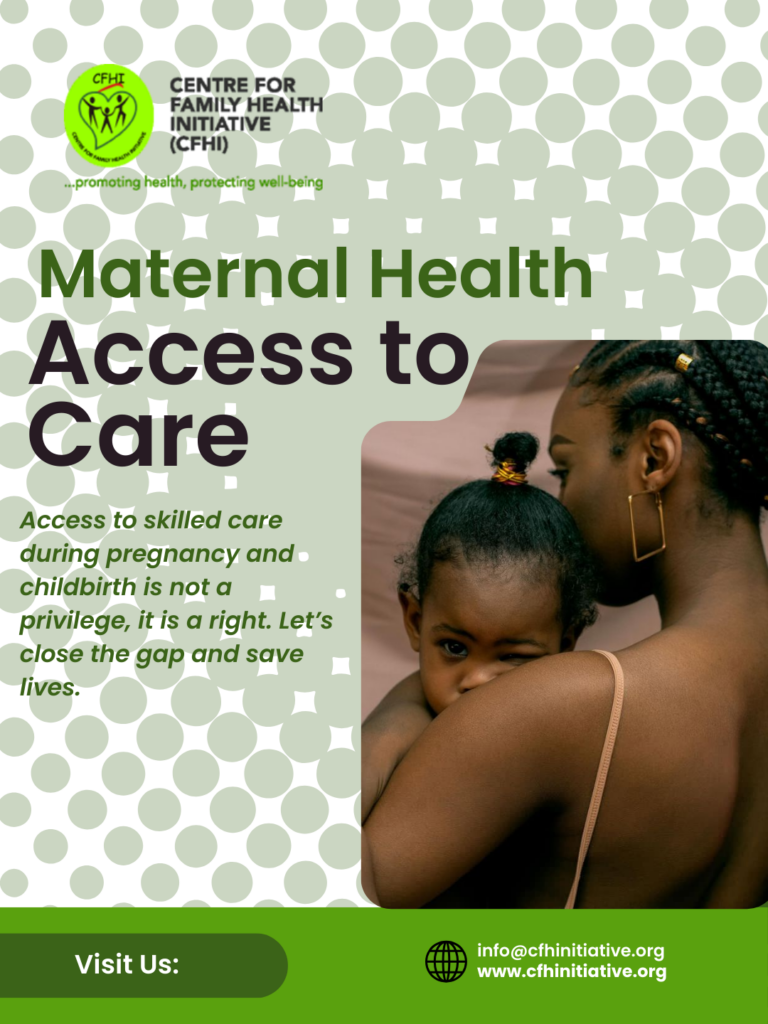
Maternal Health – Access to Care
Nigeria’s maternal health landscape continues to reveal stark inequalities that jeopardize the lives of women and newborns, particularly in underserved states like Adamawa and Zamfara. Despite global and national efforts to improve maternal survival, access to essential care remains limited for millions of women across the country. Research shows that utilisation of maternal healthcare services including antenatal care, skilled delivery, and postnatal care is persistently low, with only about 52% of women attending at least four antenatal visits, 38% delivering in health facilities, and about 37% receiving postnatal care. These gaps contribute directly to preventable complications and deaths during pregnancy and childbirth. ¹
According to the 2024 Nigeria Demographic and Health Survey (NDHS), while antenatal care coverage has improved to 63%, only 46% of births are attended by skilled health personnel, leaving more than half of Nigerian mothers vulnerable during their most critical hour.² The stakes are staggering; a woman in Nigeria faces a 1 in 19 lifetime risk of dying during pregnancy or childbirth, compared to 1 in 4,900 in high-income countries.³ Despite these daunting statistics, recent government reports from the 2025 Joint Annual Review indicate a 17% reduction in maternal deaths across high-burden areas, driven largely by initiatives like the Maternal and Neonatal Mortality Reduction Innovation Initiative (MAMII), which facilitated over 4,000 free Cesarean sections and revitalized 435 health facilities within one year.⁴
At the heart of this changing landscape is the work of the Centre for Family Health Initiative (CFHI) through the BIRTH Project (Building Innovative Responses to Transform Healthcare), currently being implemented in Adamawa State and Zamfara State. In these regions, where geographical, financial, and systemic barriers often stand between a mother and survival, CFHI’s interventions are providing practical and life-saving solutions to improve access to skilled maternal care.
In Adamawa State, CFHI strengthened the Rumde Primary Health Care Centre in Yola North by installing a solar-powered birth suitcase, ensuring uninterrupted delivery services even in the absence of stable electricity. The intervention has become the primary source of light during childbirth in the facility, enabling safe deliveries at all hours. Beyond the health facility, the project promotes maternal wellbeing through community-led nutrition demonstrations aimed at preventing maternal anemia, a condition responsible for a significant proportion of pregnancy-related complications worldwide³.
In Zamfara State, where facility-based delivery rates have historically been low, similar solar-powered birth kits were installed at facilities such as Shagari Primary Health Centre, improving nighttime emergency response and increasing community confidence in the health system. However, the BIRTH Project goes beyond the provision of equipment. It directly addresses the five delays identified under the Maternal and Neonatal Mortality Reduction Innovation Initiative (MAMII).
The consequences of poor access are not only clinical but social and economic. Women who cannot reach care in time often resort to unskilled birth attendants or home deliveries, increasing the likelihood of complications and long-term disability. National analyses show that financial constraints, distance to facilities, and perceived poor quality of care are major determinants of home births, even among women who attend antenatal care. ⁶ Beyond these structural issues, cultural norms and limited decision-making autonomy further restrict women’s ability to seek timely and appropriate maternal healthcare.
To transform maternal health outcomes in Nigeria with Adamawa and Zamfara as case studies sustained investment is required in strengthening primary healthcare systems, expanding referral networks, improving emergency transport, and increasing the availability of skilled health workers trained in emergency obstetric and newborn care. Governments, donors, and civil society must work together to remove financial barriers, improve transportation systems, and empower women socially and economically so that no woman is forced to choose between distance and survival.
CFHI’s ongoing MNCH interventions demonstrate that progress is possible when communities are engaged, health systems are supported, and maternal care is prioritized. The task ahead is to scale these efforts with urgency, political commitment, and adequate funding to ensure that every pregnancy is safe, and every mother survives childbirth.
Monday Health Burst is an initiative of CFHI to address issues of basic health concern. Join us every Monday on all our social media platforms for more episodes.
References
- National Library of Medicine (PMC). Determinants of maternal healthcare service utilization in Nigeria.
https://www.ncbi.nlm.nih.gov/pmc/articles/PMC - National Population Commission (NPC) Nigeria and ICF. Nigeria Demographic and Health Survey 2024 (Key Indicators Report).
https://dhsprogram.com - World Health Organization (WHO). Trends in Maternal Mortality 2000–2023.
https://www.who.int/publications - Federal Ministry of Health Nigeria. 2025 Joint Annual Review Report & MAMII Initiative Update.
https://health.gov.ng - National Library of Medicine (PubMed). Barriers to facility-based delivery after antenatal care attendance in Nigeria.
https://pubmed.ncbi.nlm.nih.gov
Maternal Health – Access to Care Read More »