
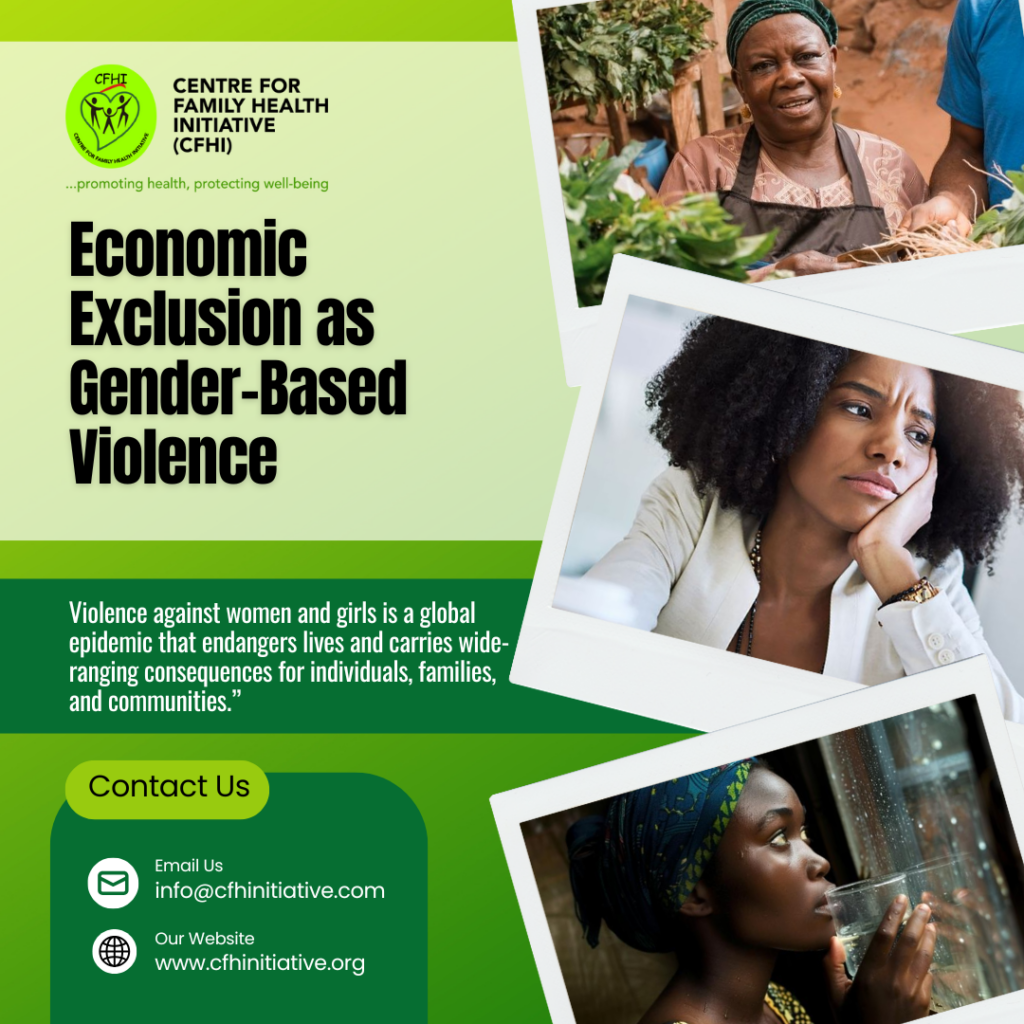
Economic Exclusion as Gender-Based Violence
Gender-based violence (GBV) is most often associated with physical or sexual abuse. However, economic exclusion – the systematic denial of women’s access to jobs, income, assets, and economic decision-making is itself a form of violence that harms individuals, families, and societies. When women are excluded from economic opportunities, the impact goes far beyond loss of income; it restricts freedom, autonomy, safety, and long-term development (1).
At its core, GBV includes economic abuse, where financial control is used as a tool of power and coercion. Economic violence may involve denying women access to money, preventing them from working, confiscating earnings, or restricting access to education and financial resources, forcing dependency and disempowerment (1). In many contexts, economic abuse is one of the most widespread yet least recognized forms of gender-based violence.
Economic exclusion is sustained by discriminatory laws, weak institutional protections, and unequal social norms. Globally, over 2.7 billion women live in countries where laws restrict the types of jobs they can do, and at least 43 economies still lack legislation addressing workplace sexual harassment, creating unsafe and unequal labor environments (2).
Intimate partner violence which frequently includes economic abuse affects approximately one in three women worldwide, limiting their ability to earn, save, and participate fully in public and economic life (3). In South Africa, studies indicate that one in eight adult women has experienced economic abuse, including being deliberately deprived of money or access to financial resources by a partner (4).
The consequences extend beyond individuals to national economies. Gender-based violence, including its economic dimensions, has measurable effects on productivity and growth. Evidence suggests that GBV can cost countries between 1–2% of Gross Domestic Product (GDP) due to absenteeism, reduced productivity, healthcare costs, and forced withdrawal from the workforce (5).
In Nigeria, the economic cost of gender-based violence is estimated at approximately USD 3 billion annually, equivalent to about 1% of the nation’s GDP, underscoring the scale of economic loss linked to women’s exclusion and abuse (6).
Economic exclusion intersects with social norms that treat women as inferior, dependent, or secondary earners. When women lack control over income, are denied access to employment, or are discouraged from education and financial decision-making, the result is structural violence a normalized and persistent denial of rights and well-being.
This exclusion is not accidental; it is deeply rooted in patriarchal systems and discriminatory practices that limit women’s autonomy and participation. The World Bank has emphasized that violence against women undermines economic growth and damages communities and future generations by restricting women’s productive potential (7).
Experts have consistently highlighted both the human and economic costs of this form of violence. According to the World Bank:
“Violence against women and girls is a global epidemic that endangers lives and carries wide-ranging consequences for individuals, families, and communities.” (7)
Research further shows that economic abuse and exclusion lead to long-term psychological harm, loss of independence, and restricted life opportunities for women and girls. Conversely, policies that promote women’s economic empowerment are associated with reduced exposure to GBV and increased participation in education, employment, and leadership (8).
Ending economic exclusion as a form of gender-based violence requires deliberate and sustained action, including:
- Strong legal protections guaranteeing equal work rights, pay equity, and safeguards against economic abuse.
- Transformation of harmful social norms that portray women as dependents rather than economic actors.
- Targeted economic empowerment initiatives that expand women’s access to education, finance, and entrepreneurship.
- Inclusive workplace policies that ensure safety, fair remuneration, and career advancement for women
Economic exclusion is not merely an economic challenge it is a human rights violation. Recognizing it as a form of gender-based violence strengthens advocacy, accountability, and policy responses, and is essential to building societies where women can live, work, and thrive free from coercion and inequality.
References
- Women’s World Banking. What is economic violence against women and why does it matter? Available from:
https://www.womensworldbanking.org/insights/what-is-economic-violence-against-women-and-why-does-it-matter/ - UN Women. Facts and figures: Women’s economic empowerment. Available from:
https://knowledge.unwomen.org/en/articles/facts-and-figures/facts-and-figures-economic-empowerment - Asia-Pacific Economic Cooperation (APEC). Violence against women: An overlooked economic barrier. Available from:
https://www.apec.org/press/blogs/2025/violence-against-women–an-overlooked-economic-barrier - Independent Online (IOL). Economic abuse: The most common yet overlooked form of GBV in South Africa. Available from:
https://iol.co.za/mercury/2025-07-02-economic-abuse-the-most-common-yet-overlooked-form-of-gender-based-violence-in-south-africa/ - International Monetary Fund. How domestic violence is a threat to economic development. Available from:
https://www.imf.org/en/blogs/articles/2021/11/24/how-domestic-violence-is-a-threat-to-economic-development - The Whistler Newspaper. Nigeria loses estimated $3bn annually to gender-based violence. Available from:
https://thewhistler.ng/nigeria-loses-estimated-3-0bn-annually-to-gender-based-violence/ - World Bank. More than 1 billion women lack legal protection against domestic and sexual violence. Available from:
https://www.worldbank.org/en/news/press-release/2018/02/01/more-than-1-billion-women-lack-legal-protection-against-domestic-sexual-violence-finds-world-bank-study - MDPI. The quest for female economic empowerment in Sub-Saharan Africa and implications for GBV. Available from:
https://www.mdpi.com/1911-8074/17/2/51
Economic Exclusion as Gender-Based Violence Read More »
 Diabetes mellitus is derived from the Greek word Diabetes, meaning Siphon (to pass through) and a Latin word mellitus meaning honeyed or sweet. This is because in Diabetes, excess sugar is found in blood as well as the urine. It was known in the 17th century as the “pissing evil”.